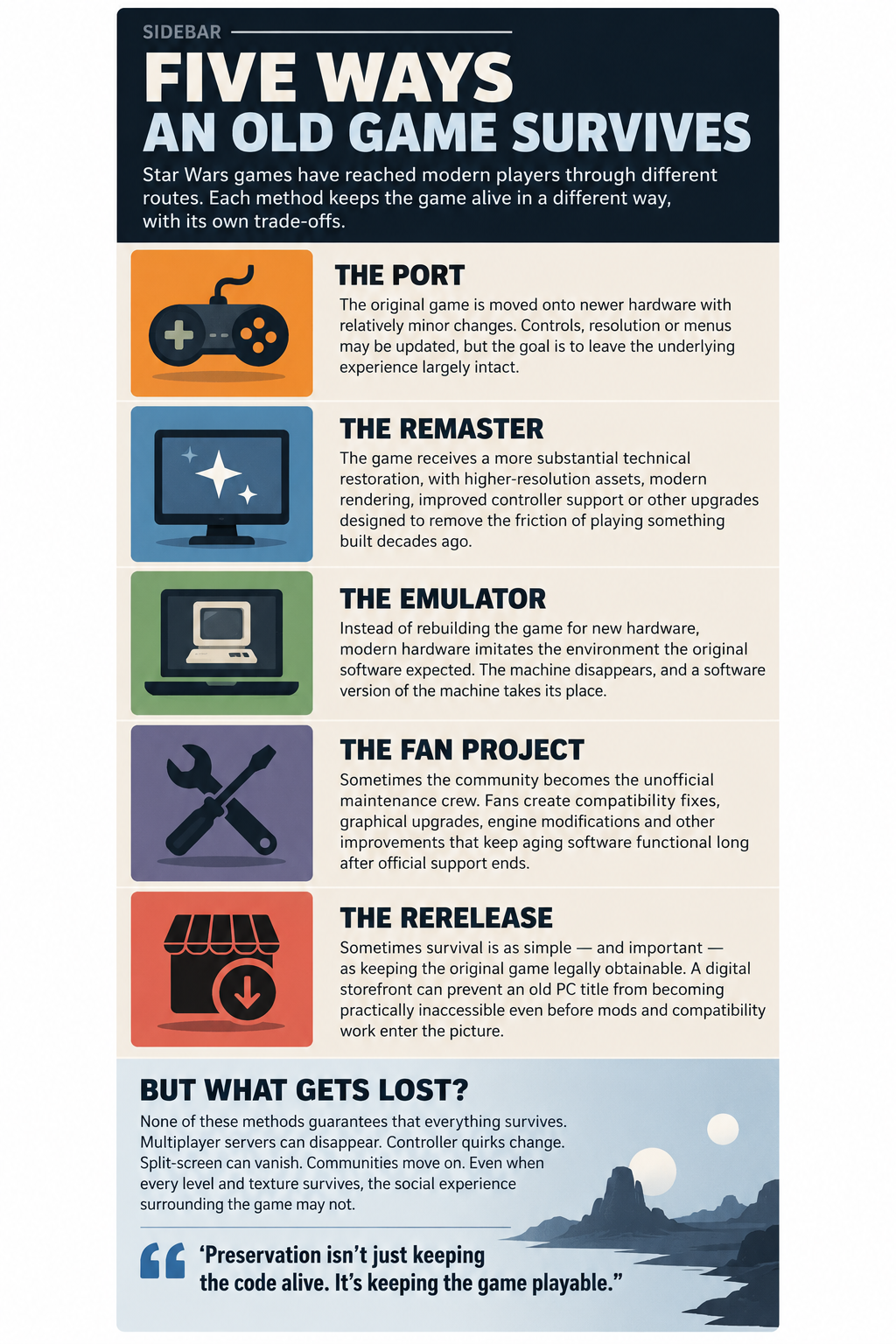
Old hardware dies. Operating systems move on. Storefronts close. Yet some Star Wars games keep finding a way back.
Somewhere in a drawer, on a shelf, or in a box that has survived three house moves, there is probably a perfectly good Star Wars game that has become harder to play than the game itself ever intended to be.
The cartridge still exists. The disc is not cracked. The manual may even be there, assuming nobody used it as a coaster in 2003. What has disappeared is everything around it: the console, the television input, the operating system, the driver, the multiplayer service, or simply the patience required to persuade old software that a modern computer is still a computer.
That is the peculiar problem of game preservation. A game can survive physically and still become practically extinct. Looking across the complete chronological archive of Star Wars games, that hardware churn becomes visible at a glance: cartridges, DOS, Windows, optical discs, memory cards, online services and several generations of consoles. Keeping that history playable has never meant doing the same thing twice.
Respawn has already explored how retro gaming is having a renaissance because old games keep finding new routes back to players. Star Wars shows what those routes actually look like: an official port here, a fan project there, a full remaster somewhere else, and occasionally a rerelease that reminds us that preserving the software is not always the same thing as preserving the experience.
When the console dies before the game
Every console generation arrives with the confidence of a new empire. The old cables go in a drawer. The new box takes the HDMI port. A few years later, the machine that once felt permanent becomes a nostalgic object with a power supply nobody can immediately identify.
That turnover matters because games were designed around assumptions that could disappear very quickly. Controller layouts, display technology, memory cards, operating systems and network services were all part of the experience. As Respawn's history of transformative console launches shows, new hardware does more than improve games. It changes the environment they are expected to live in.
Preservation therefore becomes an act of translation. The question is not only whether old code can run, but whether enough of the old relationship between player, machine and game can be carried forward without turning the result into something else.
That hardware cycle sits neatly beside The Console Launches That Changed Gaming Forever. Preservation begins where the launch-day excitement ends: when yesterday's revolutionary box becomes tomorrow's compatibility problem.
Episode I: Racer and preservation by translation
Star Wars Episode I: Racer is a wonderfully simple example. In 1999, it belonged to the Nintendo 64 and PC era, with later versions on other platforms. It was built around speed, split-screen racing, chunky controllers and the cheerful assumption that the best way to learn a course was to hit the same canyon wall until you stopped doing it.
Two decades later, Aspyr brought Racer to PlayStation 4, Nintendo Switch and Xbox One. The modern releases kept the structure of the original while adding contemporary controller support and platform-specific conveniences. Split-screen remained on supported versions. The goal was not to redesign Racer into a 2020 racing game. It was to make the 1999 game understandable to 2020 hardware.
This is preservation as translation. Change the doorway, not the room.
Episode I: Racer makes the same case from the other direction. The game has lasted because its central fantasy was always unusually clear: two engines, absurd speed, and a rock wall arriving one second earlier than expected.
The port can become the archive
Knights of the Old Republic offers a quieter version of the same story. BioWare's 2003 RPG began on Xbox and PC, but it now exists on a much wider range of hardware. Aspyr's Switch version is explicitly a port of the original, with relatively small adjustments for the newer machine. That sounds almost boring, which is precisely why it matters. Sometimes the most valuable thing a port can do is remain boringly faithful while removing the technical barrier between an old game and a current player.
Republic Commando shows the trade-off more clearly. Its 2021 return on Switch and PlayStation modernized controls and presentation, making the single-player campaign easy to play again. But the original multiplayer did not come with it. The campaign survived the journey. One room in the house stayed behind.
That distinction matters because a game is more than its executable. Modes, servers, local routines and the people who gathered around them can be part of what players remember as the game. Preservation often succeeds by choosing what must be carried forward, which also means choosing what can be lost.
KOTOR: a faithful port can become a practical archive.
Republic Commando: the campaign returned, while the original multiplayer did not.
When the fans become the maintenance department
PC games have a different problem. A console becomes obsolete as a single object. A PC game can be stranded one operating-system update, graphics API change or driver revision at a time.
X-Wing Alliance is one of the best Star Wars examples because its survival has become a partnership between commercial availability and community labour. The 1999 space sim remains sold through GOG for modern Windows systems, which solves one enormous problem: there is still a legitimate copy to buy. The community then goes much further.
The X-Wing Alliance Upgrade project has spent more than two decades replacing low-detail models, increasing texture resolution and developing engine hooks, shaders, dynamic cockpits and VR support. At that point, 'modding' feels almost too small a word. The fans have become a maintenance department for software whose original developers could never have planned for today's hardware.
This is not preservation as a frozen museum object. It is preservation as continued use. The game remains itself because people keep altering the scaffolding around it.
X-Wing Alliance closed out LucasArts' classic flight-sim line in 1999, but its afterlife has become a second history written by digital storefronts and fan engineering.
The classic X-Wing cockpit belonged to a PC world that no longer exists in quite the same form. Keeping that fantasy playable has required continual translation.
Dark Forces and the difference between emulation and restoration
Then there is the remaster, which sits somewhere between preservation and restoration. Dark Forces began in 1995 as a DOS shooter on LucasArts' Jedi engine. Nightdive Studios' 2024 remaster moved it into the KEX engine, retained the original fourteen levels, and added modern rendering, high-resolution assets, controller support and high frame-rate output on current hardware.
Those improvements are obviously not authentic to 1995. Nobody was standing beside a beige tower complaining that the Dark Trooper corridor lacked 120 frames per second. The better question is whether the changes let modern players encounter the design of Dark Forces without requiring digital archaeology first.
Good restoration makes itself useful and then gets out of the way. It removes friction without pretending the old game was secretly made yesterday. In that sense, a good remaster resembles film restoration: clean the print, stabilize the image, make it accessible, but resist the urge to add things simply because modern technology can.
That is why the physical return of Dark Forces Remaster matters in a preservation story. A game born as a DOS release did not merely remain downloadable. Three decades later, it returned to the shelf.
Preserving the game is not always preserving the experience
Star Wars Battlefront Classic Collection is where the story becomes uncomfortable, and therefore more useful. On paper, the 2024 collection was exactly the sort of thing preservation-minded players should want: both classic Battlefront games on current platforms, large online battles, bonus content and local split-screen in the package.
Then launch happened. Aspyr acknowledged serious network problems, including high ping, matchmaking errors, crashes and servers failing to appear. Updates followed. The software was available. The maps were there. The modes were there. Yet for many players, the thing they wanted back was not merely a list of files and features. It was the memory of Battlefront nights that worked.
Multiplayer is brutally difficult to preserve because it depends on infrastructure and people. A single-player campaign can be carried forward as a relatively contained object. Multiplayer needs servers, matchmaking, a healthy population and, sometimes, the person sitting beside you shouting because you took the hero pickup again.
That social dimension is exactly what Respawn explored in The Rise and Fall of Local Multiplayer. Couch multiplayer was never merely a technical feature. Preserve the code but lose the arrangement around it, and something important has still disappeared.
What exactly are we trying to save?
Preservation conversations can become technical very quickly: source code, disc images, emulation accuracy, API wrappers, server binaries. All of that matters. Players, however, rarely remember games as software inventories. They remember where they were, the controller they used, the save file they refused to delete and the small rituals required to make the thing work.
The physical objects around a game helped shape the way it was understood and remembered. When hardware changes, preservation has to decide whether it is saving only the program or some trace of the relationship people had with it.
Star Wars games have survived through almost every method available. Official ports keep older console games accessible. Nightdive restored Dark Forces. GOG keeps old PC releases commercially obtainable. Fans keep X-Wing Alliance talking to hardware that arrived decades after it did. Battlefront Classic Collection showed how difficult it is to reconstruct a multiplayer experience even when the original games themselves are sitting right there.
None of those methods is perfect. Together, they are the reason a surprisingly large part of Star Wars gaming history remains playable instead of merely watchable on YouTube.
The machine dies. The game gets another life.
There is a comforting temptation to think old games survive because great games are immortal. They are not. They survive because people keep doing things for them.
Someone ports the controls. Someone rebuilds the renderer. Someone keeps a digital copy for sale. Someone fixes the network code. Someone spends decades pushing an old engine beyond what its creators expected. Someone decides that a game from 1995, 1999 or 2005 is still worth the trouble.
The machines Star Wars games were built for were never permanent. Neither were the operating systems, cables, storefronts or services around them. What turned out to be more durable was the desire to keep playing.
A game does not survive because the cartridge, disc or executable survives. It survives because, every time the hardware disappears, somebody decides the game is still worth getting to work again.