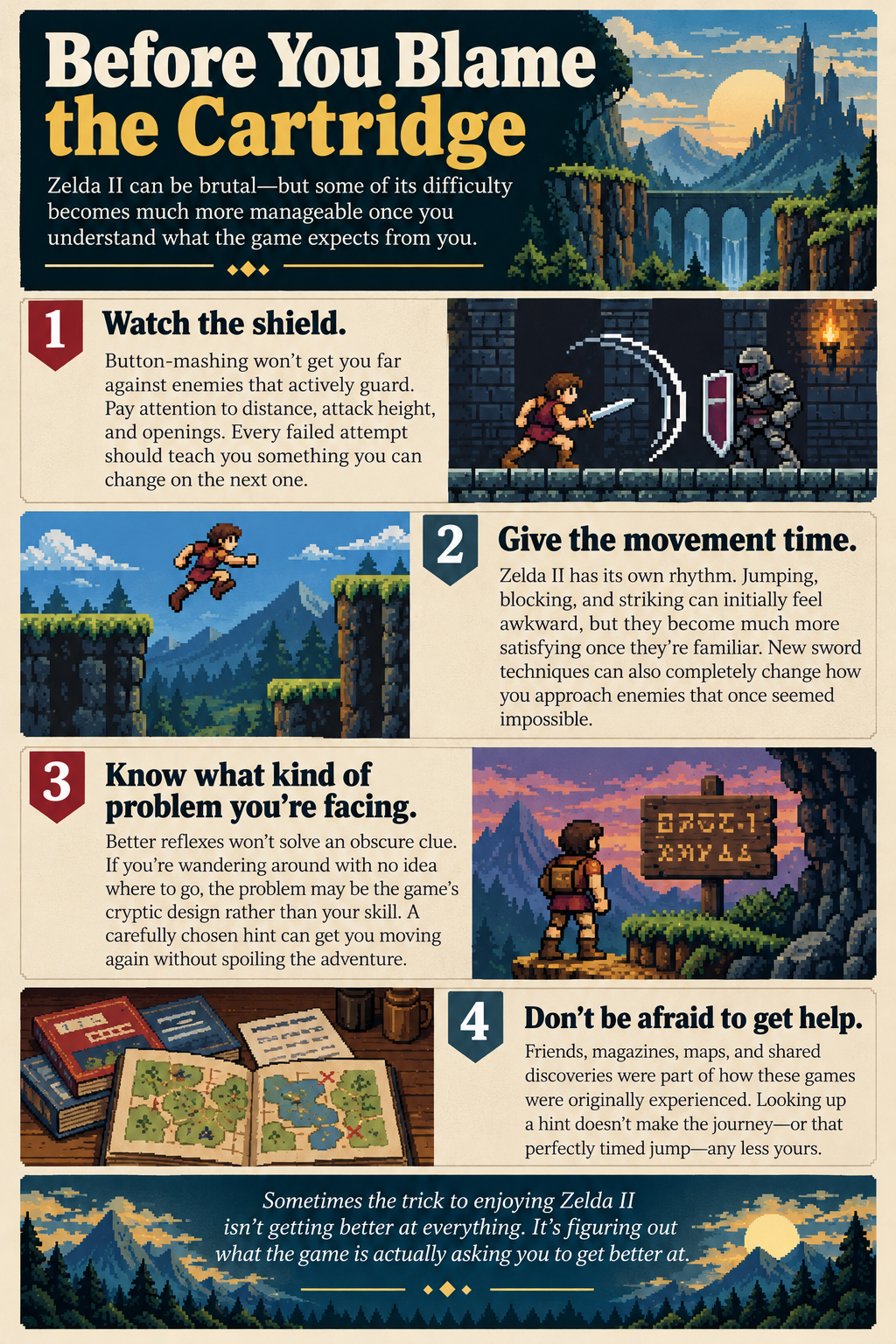
The knight blocks your sword. You swing again. Another block. Then he hits you, and a promising trip through the palace starts looking like another long walk from the beginning.
Welcome to Zelda II. Apparently, the enemy read the instructions.
This is the game people warn you about. The strange sequel. The brutally difficult one. The Zelda that went sideways, quite literally, when everyone wanted another adventure like the first. Its reputation has been hanging around so long that you can almost hear the complaints before the title screen appears.
I’ve beaten it many times, and I think that reputation sells it short. There’s a moment when Link’s movement starts making sense, when jumping, blocking, and striking become comfortable instead of desperate. The knight who seemed impossible becomes an opponent you know how to handle.
That’s when Zelda II opens up. And that’s the game I wish we talked about more.
Hang On. This Is Zelda?
The first Zelda gave us Hyrule from above. We explored, poked around for secrets, and took our growing collection of equipment into dungeons. You could get lost, but you were learning a world that gradually became familiar.
Then the sequel changed the arrangement. You still crossed an overhead map, but touching an enemy or entering a town, cave, or palace dropped you into a side view. Suddenly, Link had room to jump. The sword fight was right there in front of you, with a shield to work around and an attack to avoid.
There were experience points, too. Attack, Magic, and Life had their own levels. Fighting could strengthen Link, while spells and new abilities gave you more ways through the adventure. Nintendo’s manual lays out the changes. It was a lot to take in if your idea of a sequel was the first game with new places to explore.
You had brought your previous Zelda experience along. The new cartridge had other plans.
Nintendo wasn’t changing the view just to dress up familiar action. In a 2016 interview, director Tadashi Sugiyama recalled Shigeru Miyamoto wanting a side-scrolling game built around high and low sword attacks and defense. The team experimented with that sword-and-shield play rather than concentrating on repeating the original’s systems.
You can feel that ambition when the fighting works. But first you have to get over the feeling that somebody moved all the furniture in a house you knew.
For some players, that was exciting. For others, it was enough to put the game away. A familiar name can create a surprisingly stubborn expectation: I liked the last one, so let me do that again.
The Shield Finally Makes Sense
An Iron Knuckle is a fine test of whether you’ve made peace with this game.
March straight up and start swinging, and you’ll discover how much punishment Link can take. The shield catches your attacks. Your next attempt comes too soon, or from the wrong position. Before long, the fight feels like an argument you’re losing.
The useful question is what happened between those hits. Were you too close? Did you attack at the wrong height? Did you jump because you saw an opening, or because standing there was making you nervous?
Once you start noticing those things, the enemy becomes readable. You can adjust your distance, change your attack, and find an opening. The hit lands. Better still, you understand why it landed. Now you have something you can repeat.
That’s the pleasure of Zelda II’s combat. Link feels good to move once you stop fighting the controls. Jumping and striking begin to flow together. Blocking becomes a decision you make in time. You start going into encounters with an idea instead of a hope.
The downward thrust adds another satisfying change. Learn it, and enemies below you become opportunities. A jump can carry an attack, and familiar stretches take on a different rhythm. Link’s little collection of moves starts doing a lot of work.
After that, a difficult fight can be something you look forward to. You want to try the timing again. You know where you made the mistake. The next attempt has a purpose.
The experience counter records one kind of progress. Your hands are making another. That’s what keeps me coming back long after I know where the adventure leads.
Yes, It Can Still Be a Pain
All right, before anyone starts throwing controllers in my direction: Zelda II earns some of those complaints.
A short clue can leave you wandering without much idea of what to try. You can understand the combat and still find yourself stuck on the route. There’s only so much pleasure in proving you can survive an area while wondering whether you’re supposed to be there at all.
Failure can also send you a long way back. In the North American version, a game over normally returns you to the North Castle and clears the experience accumulated toward your next level. Earned levels and saved items remain, but the journey still has to be made again.
That’s where patience starts wearing thin. You were learning a particular encounter, and now there’s travel between you and the next attempt. Lose enough times, and the return trip becomes the part you dread most.
Sugiyama acknowledged that the developers’ familiarity helped pull the difficulty toward a level they themselves enjoyed. Anyone who has become comfortable with a game will recognize the problem. A sequence can seem straightforward once you’ve forgotten how much you had to learn to get there.
I don’t want those rough edges explained away. They belong in the review. But so does the difference between a frustrating setback and a fight that becomes terrific once you understand it. Zelda II contains plenty of both.
Pass the Magazine
Picture the practical problem: you know someone who’s farther into the game, and you want to know how they did it.
That was a useful kind of gaming conversation. A difficult enemy, a confusing route, or a newly discovered item gave players something specific to compare. Someone could explain a trick, point out an opening, or show you a map. You went back to the controller with another possibility to try.
The January–February 1989 issue of Nintendo Power devoted seventeen pages to Zelda II. That’s a substantial chunk of a magazine to put behind an adventure. The maps and explanations offered a way into the game’s challenges, and the pages gave readers information they could carry into their own conversations.
Imagine being the person with that issue when someone else was stuck. You had something useful. A discovery could move from a printed page to a friend’s game, with a bit of explanation along the way. The magazine might supply the route, but the player still had to make it through.
A fight worked a little differently. Seeing someone handle an enemy could reveal what repeated failed attempts hadn’t worked. There was the distance you needed. There was the moment to jump. The same controller, the same knight, and suddenly a better idea of what was possible.
In our case, my dad called Nintendo’s help line because we kept losing to Dark Link after all the effort of reaching him. They told us to crouch in the corner and keep stabbing. It worked. I suspect the call wasn’t cheap, but I remember the relief of finally getting past him. One tip, and the last obstacle was gone.
Help came in different forms, and it wasn’t available to everyone in the same way. But exchanging it gave these adventures a life outside the television. Reaching another palace became something to report. A discovery became something to pass along. Getting unstuck could be a shared achievement, even when one person did the playing.
The less cheerful side of that exchange was how quickly frustration could become a verdict. Someone hated the combat, or wanted the old view back, and the next player heard about it. A borrowed cartridge could arrive with an opinion already attached.
It’s easy to underestimate what that does. Arrive expecting a great adventure with a difficult opening, and you might give the controls time. Arrive expecting Nintendo’s big mistake, and every blocked attack seems to confirm the warning. You can stop playing before the rhythm has a chance to settle.
That doesn’t make every criticism secondhand or unfair. It does make reputation part of the experience. We learned games from each other, but we also learned which ones we were supposed to like.
Zelda II is worth remembering through both sides of that culture: the complaints that followed it, and the shared knowledge that helped players discover why it was worth finishing.
Give the Sequel a Fair Fight
So, was it really that bad? I don’t think so. Was it really that hard? Sometimes, absolutely. But the better question is what happens after you learn how it wants you to play.
The awkward beginning doesn’t tell the whole story. Link’s movement becomes comfortable. The swordplay becomes deliberate. You start seeing enemies as little contests to solve, and a palace becomes more than a place to lose your lives.
That’s why I hesitate when Zelda II is dismissed for being different. The difference is where much of its pleasure lives. Take away the side view, the jumping, and the high-and-low exchanges, and you’ve removed the things I enjoy most.
We still do this with sequels. We want the excitement of something new, with the reassurance that everything we liked will be waiting for us. When a game changes direction, disappointment can arrive before curiosity gets a turn.
Nobody has to love Zelda II. Its obscure clues and costly setbacks can remain irritating even after the fighting clicks. But it deserves to be judged by the adventure it offers, with enough room for players to discover what makes that adventure work.
I’ve beaten it many times because I enjoy playing it. There’s satisfaction in landing a jump, finding the opening, and getting through an encounter cleanly. The game that once seemed determined to knock you back has given you the tools to answer.
The knight raises his shield again. This time, you have a plan.