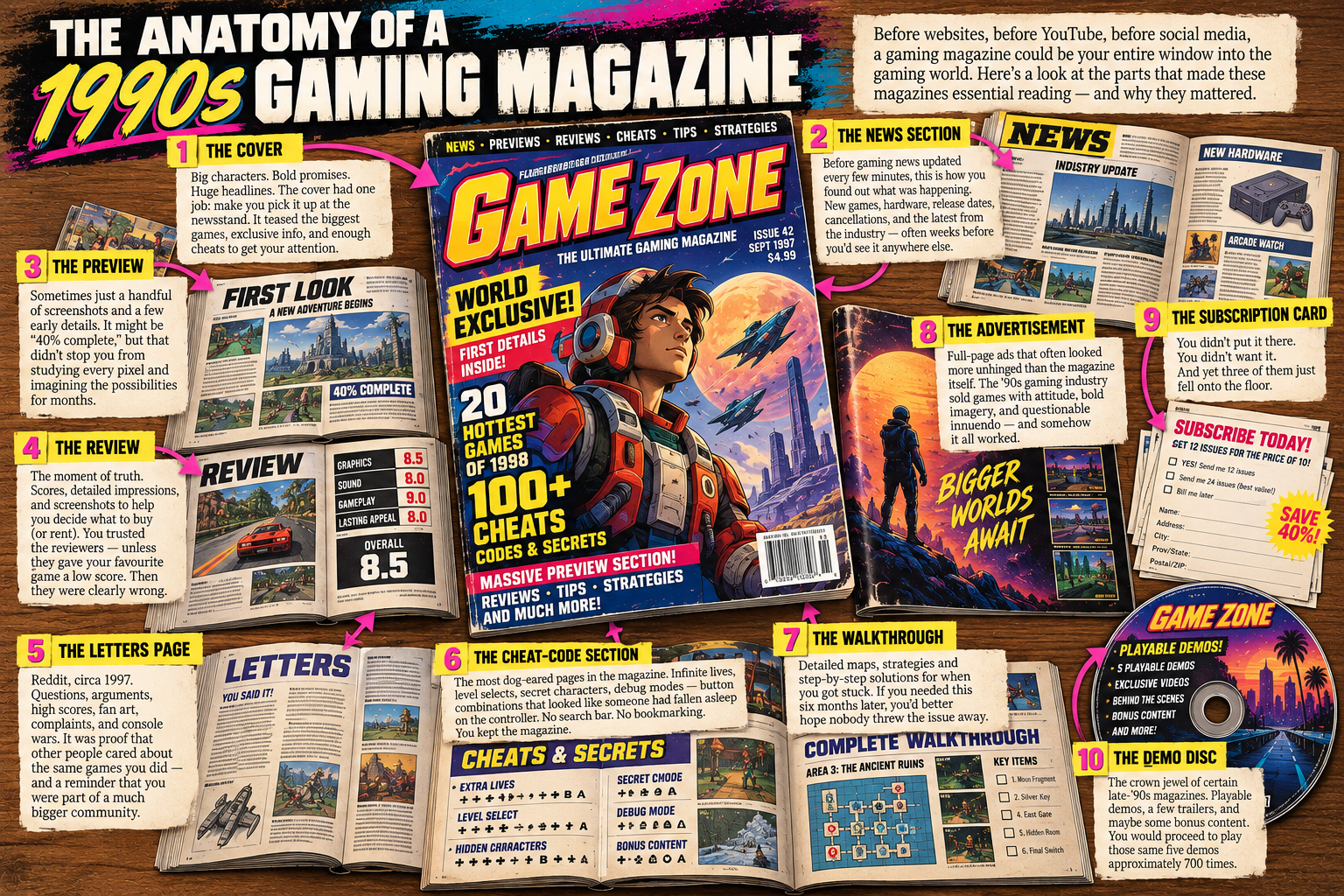
Before websites, YouTube, Reddit, social media, and instant trailers, gaming magazines were where gaming culture happened.
Picture it: You walk into a convenience store, book shop, grocery store, or up to a newsstand, and you see a new gaming magazine. You hadn’t already seen everything inside of it online. The cover itself bore exciting news that you’d never encountered anywhere.
That was the standard experience of gaming news in the 1990s and early 2000s, before a new game could be announced, dissected, streamed, memed, reviewed, and declared dead within 48 hours. In the magazine era, information moved differently. You might wait an entire month for screenshots, previews, cheat codes, reviews, or rumours.
Gaming magazines weren’t simply a delivery mechanism for gaming news. They were one of the institutions that created gaming culture in the first place.
Before the Internet, Magazines Were the Internet
In the 1990s and early 2000s, before online journalism was really a thing, gaming magazines provided a great deal of information, entertainment, and engagement for gamers.
These magazines would often cover breaking news, release dates for upcoming games, reviews of recent launches, screenshots of upcoming games, walkthroughs and strategy guides, cheat codes, rumours, letters from readers, and more.
On top of that, they even had contests and, sometimes, demo discs, posters, maps, or other physical extras.
At the time, reliable information about gaming was scarce. A handful of screenshots from a new game could sustain months of speculation. For kids in small towns, gaming magazines might be the only way they learned that an obscure game – or even an entire console – existed.
The internet gives players infinite information. But gaming magazines made limited information feel precious.
Nintendo Power and the Magazine as a Club
Nintendo Power is the clearest example of a magazine becoming part of someone’s gaming identity.
The magazine launched in 1988, featuring maps, screenshots, tips, and elaborate game coverage for gamers. The famous Super Mario Bros. 2 first issue popularized the sequel to Super Mario Bros. in a way that no other media coverage could.
This magazine was also unique in that it gave Nintendo the ability to communicate directly with its audience. Subscribers felt like they belonged to something.
While the magazine contained obvious corporate promotion, that didn’t necessarily diminish its appeal to young readers.
Sure, Nintendo Power wasn’t independent journalism. But culturally, that’s not the point. Nintendo Power created an entire Nintendo-centric world readers could enter every month.
Electronic Gaming Monthly and the Rise of Independent Gaming Journalism
The “club” model of gaming journalism was an important part of early gaming culture, but it eventually gave way to enthusiast journalism that gave gaming journalism much-needed objectivity.
Electronic Gaming Monthly helped to establish conventions that eventually migrated online, including multi-reviewer scoring, industry news, previews, rumour columns, interviews, coverage across competing platforms, and strong editorial personalities.
The writers themselves became recognizable voices in gaming, which was an important evolution for gaming journalism as an institution.
Plus, Electronic Gaming Monthly helped to advance gaming culture through its infamous Sheng Long April Fools’ Day joke. The joke demonstrated just how much authority gaming magazines had at the time: If something appeared in print accompanied by convincing screenshots, readers had few ways to immediately disprove it.
GamePro, Tips & Tricks, and the Personality of Print
Some younger readers may vaguely remember magazines like GamePro. This magazine offered a distinct rating system, reviewer personas and pseudonyms, screenshots, colourful layouts, and walkthrough material that was unrivalled at the time.
The tips & tricks section of the magazine became well-known for providing strategy and advancing cheat code culture. Cheat codes became something players collected and traded, or sometimes even hoarded like dragons.
The British Magazines Were Their Own Universe
North America’s gaming magazines are well-known for providing sponsored and independent journalism in the form of infotainment. But the British magazines mastered personality-driven journalism with their irreverence and their sarcastic editorial voices.
Gaming magazines like Computer and Video Games, Mean Machines, Amiga power, ACE, and GamesMaster contributed to a unique British gaming magazine culture that was, in many ways, less serious than North American culture. Gaming magazine culture wasn’t monolithic – different countries and platforms developed their own editorial voices and communities.
The Letters Page Was Social Media Before Social Media
Reader letters were a unique part of gaming magazines that provided players with something remarkably important: Proof that other people cared about this stuff too.
Players would often write in with questions to editors, arguments about consoles, high scores, fan art, tips, rumours, jokes, and complaints about reviews that helped give a sense of community to gaming magazines. The reader contribution section was even an early version of the platform wars, with different readers espousing different views.
Now, these letter pages weren’t identical to Reddit or Discord. But they performed the same fundamental function: Connecting otherwise isolated enthusiasts. A reader didn’t just consume gaming information; they participated in a gaming community.
The Demo Disc: When the Magazine Came With Games
The late 1990s and early 2000s era of gaming journalism became increasingly focused on the magazine as a multimedia package. Demo discs would often find their way into PlayStation magazines, PC gaming magazines, and other official console publications.
For many players, these demo discs became games unto themselves. People would replay the same demos repeatedly because buying the fullg ame wasn’t always possible.
And sometimes, the demo became the thing you remembered more vividly than the game it was advertising.
Why Gaming Magazines Died
Gaming magazines didn’t die an immediate, dramatic death. Rather, the advantages these magazines provided slowly eroded as the Internet gradually took over every function they performed.
News sections were replaced by social media. Reviews and walkthroughs became YouTube’s domain. Cheat codes migrated to GameFAQs. The community took to Discord and Reddit. Trailers and screenshots were uploaded instantly by publishers.
By the time smartphones and social media became ubiquitous, waiting several weeks for gaming information made very little sense.
But when everything went online, something was lost along the way.
What We Lost
The Internet is unquestionably faster and more useful than a print magazine. There’s nothing special about waiting a month to discover information you can now get in 10 seconds.
But something changed culturally.
Gaming magazines offered curation: Someone decided what deserved your attention.
They also offered scarcity and anticipation. Information felt more valuable because you couldn’t get everything instantly, which is why a handful of screenshots could fuel imagination for weeks.
Plus, each writer or editor had their own unique personality that made it feel like you had a real relationship with them.
That’s to say nothing of the physical memory of covers, posters, demo discs, and dog-eared issues; these all became artifacts of someone’s gaming life.
Finally, gaming magazines offered a shared experience for huge groups of players who could all encounter the same information at the same time.
Today, gaming culture is larger than ever. But it’s also vastly more fragmented, meaning shared experiences are fewer and farther between.
The Culture Outlived the Magazines
Magazines disappeared from newsstands because technology made their primary function obsolete.
But their cultural DNA lived on.
Gaming websites inherited their reviews and previews. YouTube inherited their walkthroughs. Reddit inherited their arguments. Discord inherited their communities. Influencers inherited their personalities. And Wikis inherited their knowledge.
Gaming magazines didn’t fail because they didn’t matter.
They disappeared because the culture they helped build became so vast that it outgrew the printed page.