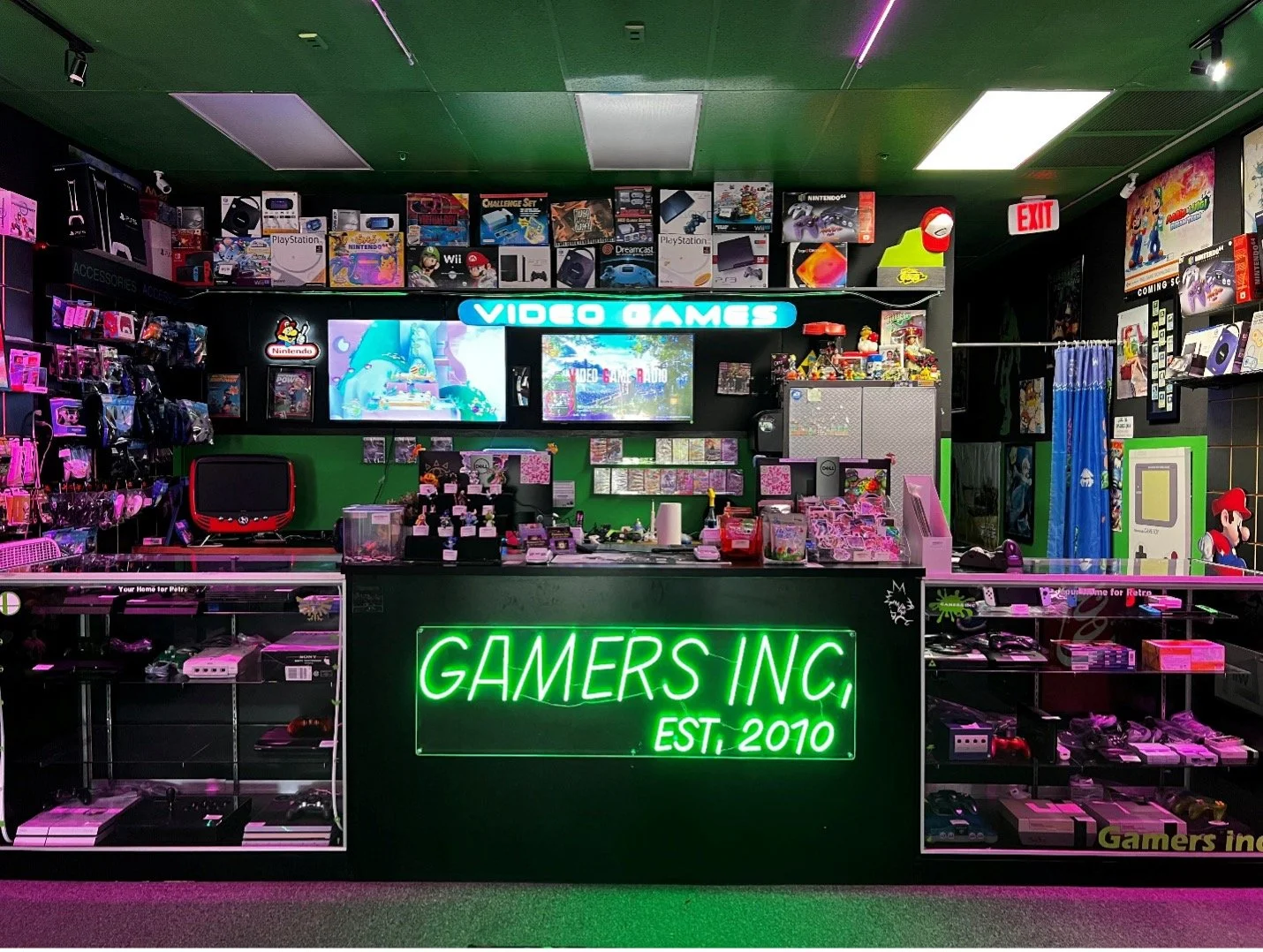
Here’s something that would have sounded absurd not long ago: some of the most enthusiastic retro game shoppers in Orlando right now are under twelve. They aren’t the parents or the collectors with colour-coded spreadsheets, though we love them too. They’re kids who walk into our game store, eyes wide, pointing at a shelf of cartridges like they just found buried treasure. There is clearly a shift going on, where kids as young as 9 are asking us for game consoles that are twice their age or even older. We at GamersGoRetro have been in the retro gaming business for over 16 years and have some unique insights into why this generation is going back to physical media that predate their own existence.
For years, people assumed retro gaming was a hobby for grown-ups chasing their childhoods, and plenty of adults are. Certain 16-bit soundtracks can still make a thirty-something misty-eyed on a slow Tuesday, but something has shifted. The generation raised on tablets, Fortnite, and 4K open worlds is reaching backward in time and falling for consoles that came out decades before they were born.
So why? What pulls kids with every shiny option on earth toward chunky pixels and clunky controllers? After all, aren’t fresh graphics and raytracing what the kids are after these days? Well, games we consider retro certainly had technology limitations to the time they were developed, but there is no limitation on the boundless creativity employed to explore their, at the time, revolutionary console capabilities. You will find no shortage of quality art in the games that came before.
Press Start. That’s the Whole Tutorial.
Think about what it takes to play a brand-new, big-budget game today. You turn on the console, and it needs an update. You launch the game, and it needs another update. Then come the logins, the splash screens, the tutorial that pauses every thirty seconds to explain a button, and finally a menu with six different currencies. By the time the actual playing starts, you’ve spent level-playing time learning what the “X” button does. Can’t forget to mention open world gaming, which has largely grown into design bloat, where you have AAA games with enormous sandboxes with very little substance. It is not to say that these games nowadays are bad, but many of them are getting away with a lot more while doing a lot less in terms of production.
Now compare that to a retro game. You blow into the cartridge (yes, everyone did it, and no, it never really helped and we do not recommend it), push it in, and hit the power button. Title screen, press start, you’re playing. The whole process takes about ten seconds. It is not to say that entering a game faster is superior, but that you could cut to the reason why you turned onto the console sooner and get to the real substance of the matter.
Younger players bring this up constantly to us. There’s no account to make, no storage to clear, no Wi-Fi password to type in. The game is the game, and it works exactly the way it did decades ago.
There’s also something freeing about how little old games ask of you. They trust you to figure things out. You learn Super Mario Bros. by walking to the right and seeing what happens. Mushroom? Grab it. Goomba? Jump on it. Pit? Maybe don’t fall in. Kids get that in about a minute, and it feels like they discovered it themselves, which adds a layer to the innately challenging nature of old school games. Difficulty is a big change from games back then to now. Today, you have the option to skip a puzzle, use AI to figure it out, or watch a YouTube tutorial about it. Back then, you just had to “get good.”
The Kid and the Game Boy Color
On one busy Saturday, a boy who couldn’t have been more than 9 years old came to us looking for GameBoy Color. A GameBoy Color, which came out in 1998, predating even the thought of him by his parents.
His mom explained that he’d been watching videos about the old Pokémon games and begged for a Game Boy for his birthday. He had already played Scarlet and Violet on his Switch, which is what grew his curiosity for Pokémon. To think that Pokémon Scarlet sent him back in time to want to play Pokémon Gold on a GameBoy Color just shows you that even a boy as young as he was knew that there was so much more to explore in the world of Pokémon that didn’t just mean to wait for the new games, but to instead go back in time to the roots of Pokémon the video game.
He already knew what he wanted to play, and the hardware he needed to play it on, and on that day, he went home with a teal GameBoy Color console and an official Pokémon Gold cartridge.
You Paid for the Game. You Own the Whole Game.
Let’s talk about money, because this is where the contrast gets wild. When you buy a retro game, you get all of it: every level, every character, every secret, every ending. Nobody asks for another $4.99 to unlock the good sword. Nobody’s selling a skin. There are no loot boxes, no season passes, and no limited-time offers flashing across the screen while you’re trying to enjoy yourself.
Don’t get it twisted, plenty of modern games are fantastic, and plenty are generous. But the industry has leaned hard into ongoing monetization, and kids feel it more than anyone. They’re the ones begging for gift cards to buy in-game currency. They’re the ones watching a friend flex a skin they can’t afford. For someone that age to simply turn on a PlayStation 2 and play Kingdom Hearts and be enthralled with hours of uninterrupted and inspired gameplay is refreshing.
There’s an honesty to retro games that people appreciate. The price on the shelf is the price. The game in the cartridge or disc is the whole game. Since it’s physical, you can lend it to a friend, trade it, or resell it when you’re done. A digital library can vanish when a service shuts down, but a cartridge just sits on your shelf, ready to go.
Star Wars Battlefront 2: The PS2 Version
An older kid, probably 12 or 13, came in wanting to pick up a copy of Star Wars Battlefront 2 for the PlayStation 4. As simple as that, he came in with his parents and brought the game to the desk to buy. After seeing the game he chose, we struck up a brief conversation about older Star Wars games. He was shocked to find out that there was another game called Star Wars Battlefront 2 which came out years prior on the PlayStation 2 and XBOX original console. Our team member put on some gameplay for him to see, and the kid was instantly enthralled. He was shocked to find a game with a similar title had actually come out years before the most current version.
This conversation quickly sent him into a frenzy wondering if we had the game. We did, and within minutes he was walking home with a PlayStation 2 and Star Wars Battlefront 2.
It says a lot when you have a kid who puts down the current modern-gen game and swaps it out for the PS2 version. It proves that quality gameplay, level design, character design, and game development is not limited to fancy tech upgrades and the amount of RAM your console employs.
It’s Challenging, and Kids Love It
Here’s the part that surprises people most: young gamers like the challenge. Old games were tough. Some of that came from arcade roots, where the goal was to eat your quarters. Some came from the fact that games were short, so developers stretched them out with difficulty. Some came from the fact that nobody had invented a checkpoint every ten feet yet. You got a limited number of lives, and when you ran out, it was back to the beginning. Ghosts ‘n Goblins and Battletoads have ended friendships.
Modern games often come with difficulty sliders, hint systems, auto-saves every five minutes, and glowing waypoints telling you exactly where to go. That’s great for accessibility, and more people being able to enjoy games is a good thing, but when everything is smoothed out, victory can feel a little hollow. When a retro game beats you ten times and you finally clear that stage on the eleventh try, it hits differently. You earned it. Nobody gave it to you.
Young gamers learn patterns, memorize enemy movements, and get better with every attempt. This more applied style of gaming requires more critical thinking points. The retry loop is instant, too: you die, you press start, and you’re right back in. There are no server issues to ruin the momentum. That feeling of improving at something is incredibly satisfying, and a generation used to accessibility seems hungry for the challenge.
Why This Stuff Sticks
There’s one more piece that matters, and it’s the part you can’t quite measure. Retro games have a charm that doesn’t depend on when you were born. The pixel art is expressive in a way photorealism just isn’t. The chiptune music gets stuck in your head for days. Every game has a distinct personality, because small teams had to make every sprite and sound count. The games do not even have to be that old; think back to the iconic soundtracks of Halo 3 or Final Fantasy 7 -- these games have so much left to offer everyone.
Then there’s the social side. A lot of kids spend their gaming time talking to strangers through headsets. Retro games bring the experience back to the living room: two controllers, one couch, and someone trash-talking you from three feet away. Playing couch co-op with someone or duking it out in Street Fighter side by side is an iconic experience, one you won’t soon forget. It’s gaming you can share with the people sitting right next to you.
Then there is the collectible nature of gaming. A cartridge is something you can hold, show off, and put on a shelf. It has a label, a weight, and a history. To this day, that red cartridge version of Maximum Carnage still draws eyes. PS1 Japanese RPG games have cover art and manuals that belong in art museums. In a world where almost everything is a file you can’t touch, that matters more than you’d think.
The Verdict
So, is it a trend? Maybe a little, but that isn’t all it is. Take a moment to shift your mindset from “old game” to “retro art” and you’ll see that enjoying a 30-year-old expression of gaming creativity is timeless in the same way that a Bernini sculpture never loses its eminence. The new generation has found something older gamers never forgot: great games are great no matter how old they are. Simple, honest, challenging, and fun will always be a winning combination.
These insights are based on interactions over the course of 16 years at Gamers Inc in Orlando. To learn more, visit https://www.gamersgoretro.com/.