Why Retro Gaming is Having a Renaissance
Hint: It’s not just nostalgia.
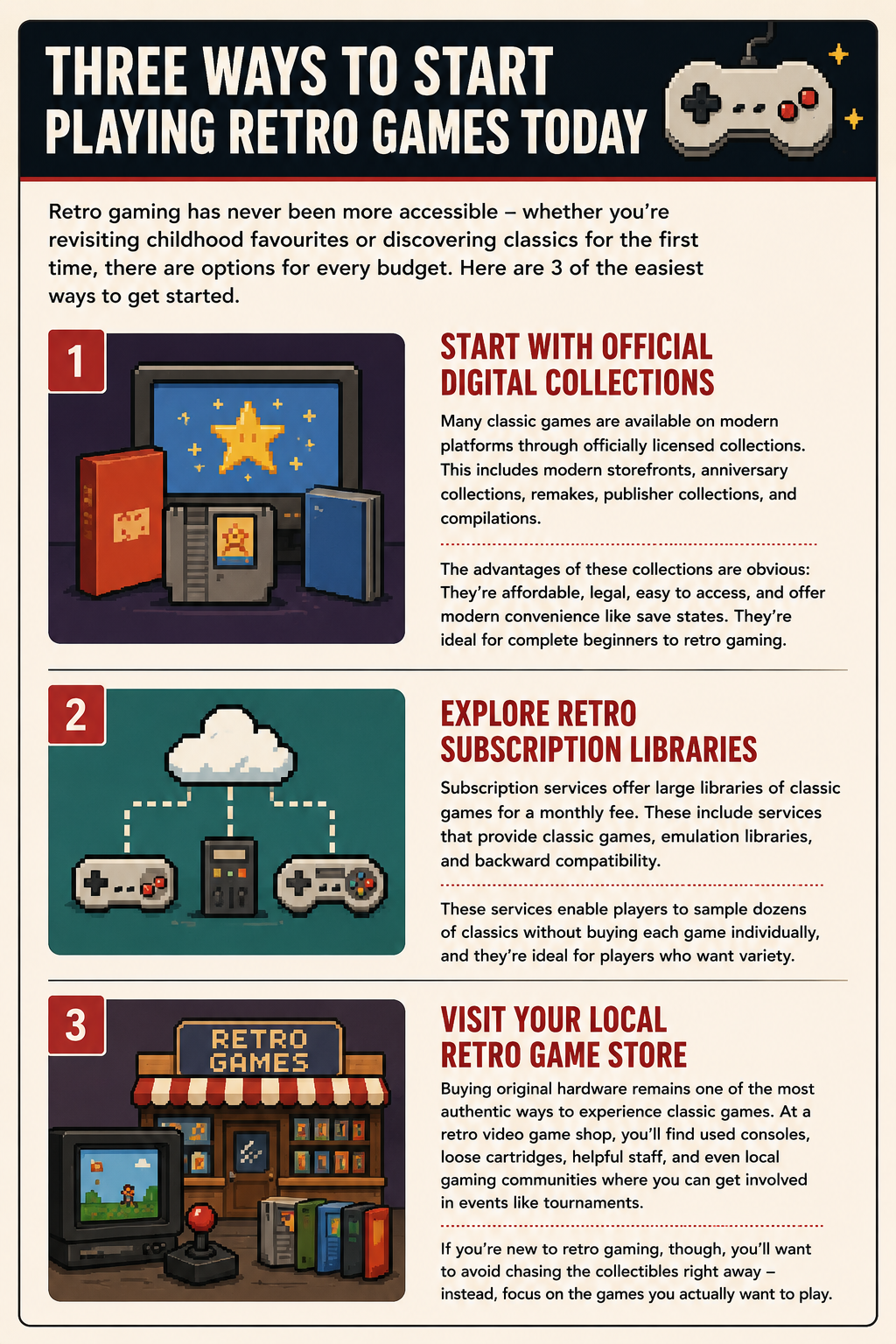
Retro gaming is no longer just a niche hobby. Classic games are showing up everywhere, from retro consoles to modern remakes. Even YouTubers are getting in on the action, with YouTube retrospectives gaining in popularity across a range of retro franchises. Twitch streamers in the retro space have become so popular that Twitch now has a retro gaming category. Plus, with new indie games coming out that have been clearly inspired by classics (lookin’ at you, Stardew Valley), a whole new generation of players is getting to experience old-style gaming in a new way. Retro gaming conventions are also boasting record attendance, proving that the retro revival isn’t just a fad – it reflects what players increasingly value about games. Here’s why retro gaming has taken off in recent years.
Nostalgia is Powerful – But It’s Only Part of the Story
Of course, nostalgia plays a big part of why retro gaming has taken off. Generation X and Millennials are increasingly looking for ways to capture the simplicity of childhood in an ever-complex world. But these generations now have disposable income, and they want to use that income to reconnect with core childhood memories.
Original hardware and collections carry immense emotional value for these generations. These are the games and systems that Millennials and Gen X grew up on; as a result, they’re a part of gamers’ identities.
But nostalgia alone doesn’t explain why younger gamers are joining the hobby. Generation Z players are getting in on the retro fun as well, and they weren’t around for the original retro era.
Nostalgia may open the door, but great game design is what keeps people playing.
Classic Games Were Designed Differently
Older games are vastly different from new games. Modern games often involve live-service mechanics, battle passes, massive downloads, endless updates, and complex control systems.
In contrast, retro games are known for their immediate gameplay (just plug in a cartridge and go), their challenge, their tight controls, their memorable level design, their limited tutorials, and their high replayability.
Modern games often come with a tutorial level that teaches players how to play the game. In contrast, retro games trusted you to “figure it out”. Retro titles like Mario, Sonic, Pokemon, and Metroid were “pick up and play” titles where you just dove into the adventure right away and discovered a new world without anyone holding your hand.
Mature gamers are accustomed to figuring things out on their own, and they gain a sense of satisfaction from discovering how a game works. For instance, figuring out a Pokemon type’s weakness during the first generation of games was an act of discovery; you had to enter the right house in the right town, or talk to the right NPC, in order to gain access to information about types and their strengths and weaknesses. In Red, Blue, and Yellow, it was never explained to you in advance whether a move would be super effective or not very effective before you selected it. In contrast, modern Pokemon games – starting with Sun and Moon – introduce a much more informative battle interface that tells you straight-up whether a move is super effective or not very effective.
Game Preservation Has Exploded
There was a time in history when, once a game exited publication, it was effectively dead – impossible to find on the free market unless you knew people. Now, though, emerging technologies have made game preservation a true art form.
ROM preservation, FPGA hardware, flash cartridges, restoration projects, digital archives, and online museums have made thousands of games more accessible than ever – even games that once disappeared.
This means that gamers have more access to retro games than they’ve ever had before, and this access is enabling a retro comeback unlike anything ever seen.
YouTube Has Created a New Generation of Retro Fans
YouTube creators bear much of the credit for the retro renaissance. With YouTube, streamers are giving console histories, creating game documentaries, doing playthroughs and speedruns, and restoring hardware in a way that’s immediately experiencable for a lay audience – thereby introducing millions of gamers to retro games they’ve never actually owned.
Many younger players, who didn’t grow up with the original hardware, have discovered retro gaming through these creators.
Indie Developers Fell in Love with the Classics
It’s no secret that modern indie hits openly borrow from older games. The ultimate example is ConcernedApe’s Stardew Valley farm simulator. ConcernedApe created Stardew Valley as a tribute to Harvest Moon, a 1997 Natsume title for the Super Nintendo. While ConcernedApe undoubtedly improved upon and expanded Harvest Moon to the point where Stardew Valley stands on its own as a unique game, it’s undeniable that there’s a direct throughline from Harvest Moon to Stardew Valley.
Plus, indie developers are happily leveraging pixelated art, 16-bit aesthetics, and chiptune music to make their games, openly borrowing from the game music and art styles of the 80s, 90s, and early 2000s.
There’s also been an explosion of Metroidvanias in recent years – games that, like Metroid and Castlevania, feature a large, interconnected, non-linear world map with ability-gated progression. Games like Hollow Knight and Ori and the Will of the Wisps openly leverage the Metroidvania approach to game design, proving that the classics still have staying power – and that retro design has become modern again.
Original Hardware Became Collectible
Old technology typically gets thrown out. But with gaming, there’s a strange phenomenon happening where the original technology we used to play games on is increasing in value every year.
Cartridge prices are rising year-over-year, fuelled by a growing interest in retro gaming and a lack of supply as original cartridges start to fail. CRT televisions are also making a comeback due to the technical challenges of creating effective ports of old games for modern TVs.
Arcade cabinets are even on the rise as collectors’ items, with rare and valuable arcade games fetching over $3,000 apiece.
Let’s also not overlook the fact that as the years go by, hardware becomes more difficult to find. Plus, complete-in-box editions of popular games are less and less common every year, giving them real collector value.
There’s a genuine excitement among players and collectors for these games, but the rising prices are making it harder than ever for collectors to maintain and expand their collections – and it’s turning some titles, like EarthBound, into something of a Holy Grail.
Modern Technology Makes Retro Gaming Easier Than Ever
Today’s players have unprecedented options when it comes to retro gaming. They can use HDMI adapters to connect original hardware to modern TVs. They can use FPGA consoles to recreate the original consoles of the 80s and 90s on modern hardware. They can use handheld emulation devices, like the Analogue Pocket, to emulate handheld games for consoles like the GameBoy.
There are even mini-consoles, like the Nintendo Classic, and digital storefronts like Nintendo’s eShop, enabling players to play old games on modern hardware. Plus, conveniences like save states and wireless controllers have provided substantial quality-of-life improvements to the gaming experience.
In sum, new technology has made old games easier to enjoy.
Communities Keep the Hobby Alive
Retro gaming is a remarkably social hobby. There are conventions, Discord servers, Reddit communities, Facebook groups, local retro game shops, repair communities, and homebrew developers keeping the hobby alive by giving retro gamers a shared space to discuss their passion. The hobby is thriving because people enjoy sharing discoveries, and these venues are giving them a place to do that.
The Industry Has Embraced Its Own History
There was a time when getting a major publisher or developer to re-release a retro title was like pulling teeth (lookin’ at you, GameFreak). But now, major publishers are increasingly celebrating their backlogs through remasters, remakes, anniversary collections, museum-style compilations, and classic game subscriptions.
Nintendo’s Switch Online + Expansion Pack is a prime example. With this online subscription service, Nintendo Switch owners can access a whole library of back titles for a variety of different systems like the Nintendo 64, the GameCube, the Virtual Boy, and more.
Great Games Never Really Die – They Respawn
Retro gaming isn’t surviving because people refuse to move on – rather, it’s thriving because timeless game design continues to resonate across generations. New generations of gamers continue discovering classics while longtime fans rediscover why they fell in love with games in the first place.
In sum, great games don’t die – they find new players.