The Console Launches That Changed Gaming Forever
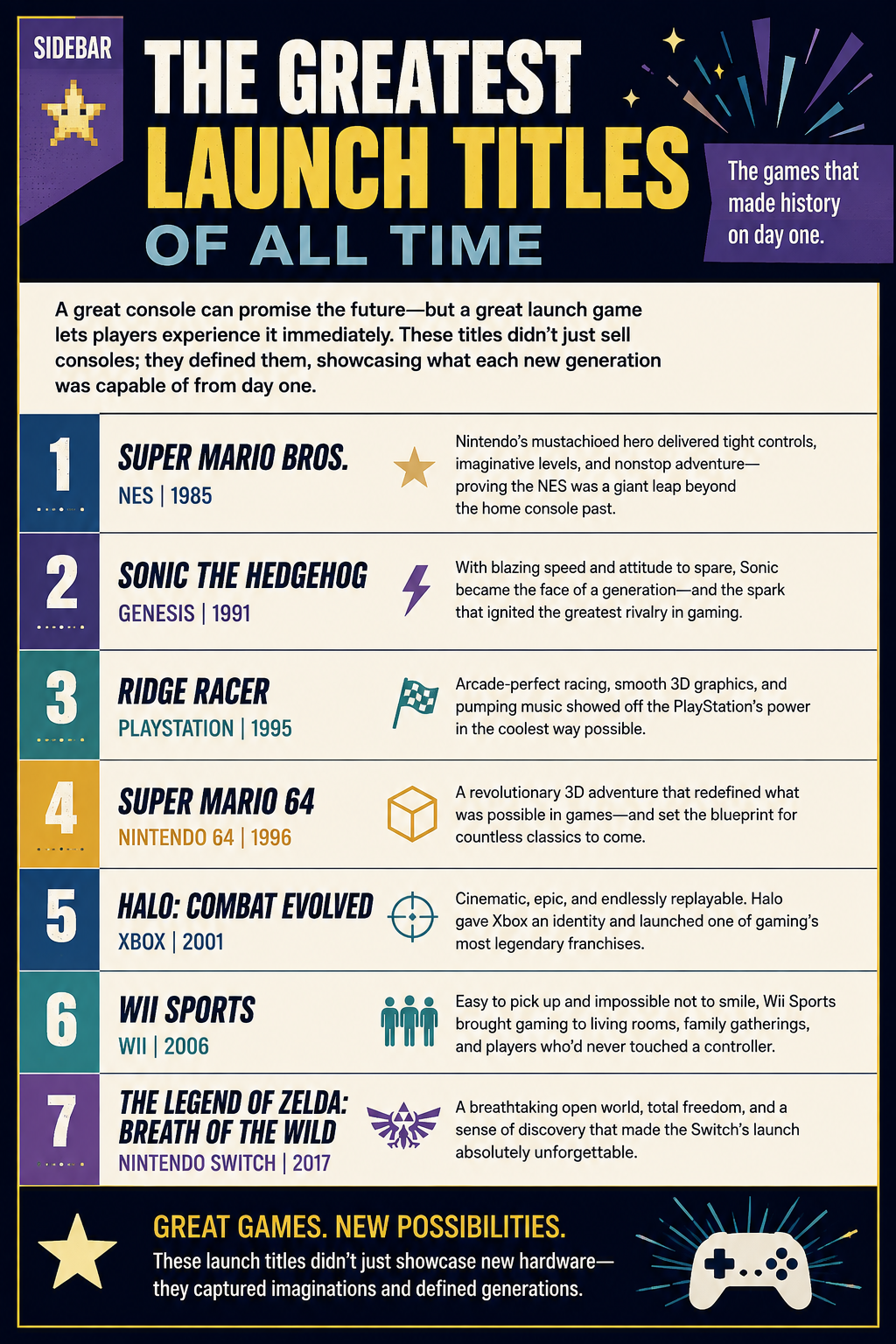
It’s about more than just new hardware.
Retro gaming enthusiasts all remember the excitement surrounding a console launch day.
The midnight lineups, the magazine previews, the demo kiosks.
Most consoles come and go with relatively little impact. But a select handful fundamentally reshaped how the industry worked, what gamers expected, and where gaming was headed.
These weren’t just successful launches – they permanently changed the direction of video games.
Here are some of the console launches that changed gaming forever.
What Makes a Console Launch Truly Historic?
In order for a console launch to be considered historic, it needs to meet a few criteria.
First and foremost, it needs to introduce revolutionary technology. Without a leap forward in tech, a console launch is just more of the same.
Secondly, it needs to expand gaming to new audiences. New console launches are just as much about making gaming more accessible as they are about hardware.
Thirdly, it needs to change the business model of video games. The best and most historic console launches in history are the ones that shook the industry out of complacency.
On that note, a historic console launch needs to create lasting industry standards in a way that forces competitors to respond.
So which console launches meet all of these criteria? Here’s our list.
The Nintendo Entertainment System, 1985
The Nintendo Entertainment System did more than just change gaming – it saved the gaming industry.
The North American video game crash of 1983 was thought to be the end of gaming altogether. Retailers had no confidence in video game systems, which is why Nintendo had to market their video game system as an “entertainment system” instead.
Thankfully, Nintendo made it easy for retailers to say yes. Now-classic peripherals like R.O.B. and the Zapper helped convince retailers that Nintendo was doing something different, which helped retailers take a chance. Strict quality control and licensing requirements on Nintendo’s part also helped; they ensured that every launch game for the NES was a banger.
Speaking of launch games, the NES had one of the strongest launch lineups in gaming history, led by the iconic Super Mario Bros. Other launch games like Duck Hunt, Ice Climber, and Excitebike helped diversify the NES’ capabilities.
The launch of the NES did more than just mark the birth of a new console. It revived the North American console market, established Nintendo as an industry leader, and created the modern first-party quality standard that we enjoy today.
The SEGA Genesis, 1989
The launch of the SEGA Genesis in 1989 marked the birth of the Console Wars. It was SEGA’s aggressive challenge to Nintendo, with SEGA taking the attitude that “Genesis does what Nintendon’t.”
Sonic arrived as the perfect mascot, full of spunk and personality. The system’s bevy of sports games helped SEGA dominate among older audiences, while the console’s many celebrity endorsements and edgy marketing made it a popular choice for gamers.
As a result, competition accelerated innovation across consoles. Game marketing became just as important as hardware, and SEGA defined gaming throughout the early 1990s.
The Sony PlayStation, 1995
The launch of the Sony PlayStation was when gaming grew up. Sony’s dramatic entry into gaming leveraged CD-ROM technology and third-party developer support to launch games like Ridge Racer, Tekken, and, later, Final Fantasy VII.
The PlayStation helped shift gaming toward teenagers and adults, changing the perception of gaming among the general public. This made PlayStation the dominant global brand and helped establish 3D gaming as the future.
The Nintendo 64, 1996
The Nintendo 64 was an innovative play by Nintendo that redefined what 3D gameplay looks like. The anaolg stick, four controller ports, and local multiplayer made the N64 a cultural phenomenon, while games like Super Mario 64, Mario Kart 64, and GoldenEye 007 made everyone want a piece of the 64-bit action.
The Nintendo 64’s legacy is undeniable. This system was responsible for modern analog controls, couch-based multiplayer, and camera controls that would shape future games.
The Xbox, 2001
Microsoft entered the console gaming arena in 2001 with its launch of the iconic Xbox. The company took a significant gamble in doing so, departing from its typical PC-based productivity software approach and adopting a whole new business model.
The Xbox was the first gaming console to offer a built-in hard drive, enabling players to save games directly to the console. The system’s broadband focus was also innovative for its time.
Games like Halo: Combat Evolved helped popularize the first-person shooter genre, while Xbox Live laid the groundwork for online gaming today.
As a result of the Xbox, online console gaming went mainstream, digital identities and friends list became part and parcel of online gaming offerings, and multiplayer expectations grew up.
The Nintendo Wii: Gaming Leaves the Basement
The Nintendo Wii represented another major leap forward for gaming, with motion controls redefining how consoles could work. The Wii Sports phenomenon made the console popular even among older gamers, and promoted the notion of families playing games together.
The Wii was even popular in retirement homes, as it gave retirees a way to stay active without having to leave the premises. And the mainstream media coverage the console received helped to boost its sales.
The Wii’s legacy is undeniable. It helped promote the explosion of casual gaming, expanded gaming demographics, and influenced the entire industry to adapt motion controls.
Honourable Mentions
There are several retro consoles that made a splash with their launches, even if they didn’t permanently reshape gaming.
The Atari 2600 was one such console, as it popularized the notion of home consoles altogether.
Another honourable mention? The Dreamcast – it was ahead of its time with online play.
The PlayStation 2 was key in driving adoption with its DVD player, while the Xbox 360 introduced gamers to the HD era and helped refine Xbox Live.
Why Some “Great” Consoles Didn’t Make the List
There are lots of retro game consoles that aren’t on our list of launches that changed gaming forever. While we appreciate these consoles, excellent hardware doesn’t always equal industry-changing. Great consoles can often refine the industry rather than revolutionize it.
The Nintendo GameCube is one example of this. The GameCube was an excellent console, and with accessories like the GB Player enabling gamers to play GameBoy games on a big screen, it had some serious functionality. But ultimately, the GameCube was iterative rather than revolutionary.
The PlayStation 5, Xbox Series X, and Sega Saturn tell the same story. All represented leap forwards in technological capabilities. But just because a console has more bits or bytes, that doesn’t make it iconic.
Launch day can change everything. If you’ve ever camped outside a video game store or read magazines months before a launch, you were watching video game history unfold without even realizing it. Every generation has exciting game system launches, but only a few permanently alter the industry’s trajectory. Most console launches introduce new hardware. A rare few introduce an entirely new future of gaming.