The Art of the Video Game Strategy Guide
The O.G. walkthroughs were an experience.
Before walkthroughs became instantly searchable, strategy guides were books that you studied, carried around, scribbled in, and sometimes collected long after you finished the game.
These weren’t mere instruction manuals – they were companions to the games themselves. If you remember getting stuck in a game pre-YouTube-era, then you know you only had a few choices.
One, experiment endlessly. Two, ask a friend. Three, call a hint line. Or four, buy the guide. These guides were oversized paperbacks with glossy screenshots, maps, charts, artwork, and frequently dog-eared pages that you’d go back to over and over again.
The best strategy guides turned solving a video game into its own form of publishing. Here’s how these books evolved – and what made them special.
From Hint Books to Strategy Guides
Early game-specific hint books and unofficial walkthrough publications proliferated when games became challenging enough to demand them. These unofficial guides often circulated through gaming communities, giving players access to knowledge they needed to complete games. But when it became clear that there was player-side demand for game knowledge, that’s when gaming magazines capitalized on it.
Gaming magazines like Nintendo Power would provide players with tips, maps, cheats, and walkthroughs, while dedicated licensed guide publishers came to the forefront of game publishing with their in-depth guides.
Prima Games and BradyGames guides were fixtures of the 1990s and early 2000s, giving players official, OEM-sponsored guides that were considered authoritative. The word “official” mattered a great deal at this time, because there were several unofficial guides that often contained errors.
The Strategy Guide as an Object
Retro video game strategy guides weren’t just information – they were works of art. The cover artwork was designed to sit beside the game box, creating a comprehensive aesthetic experience. Meanwhile, full-colour screenshots and illustrations gave these guides experiential value.
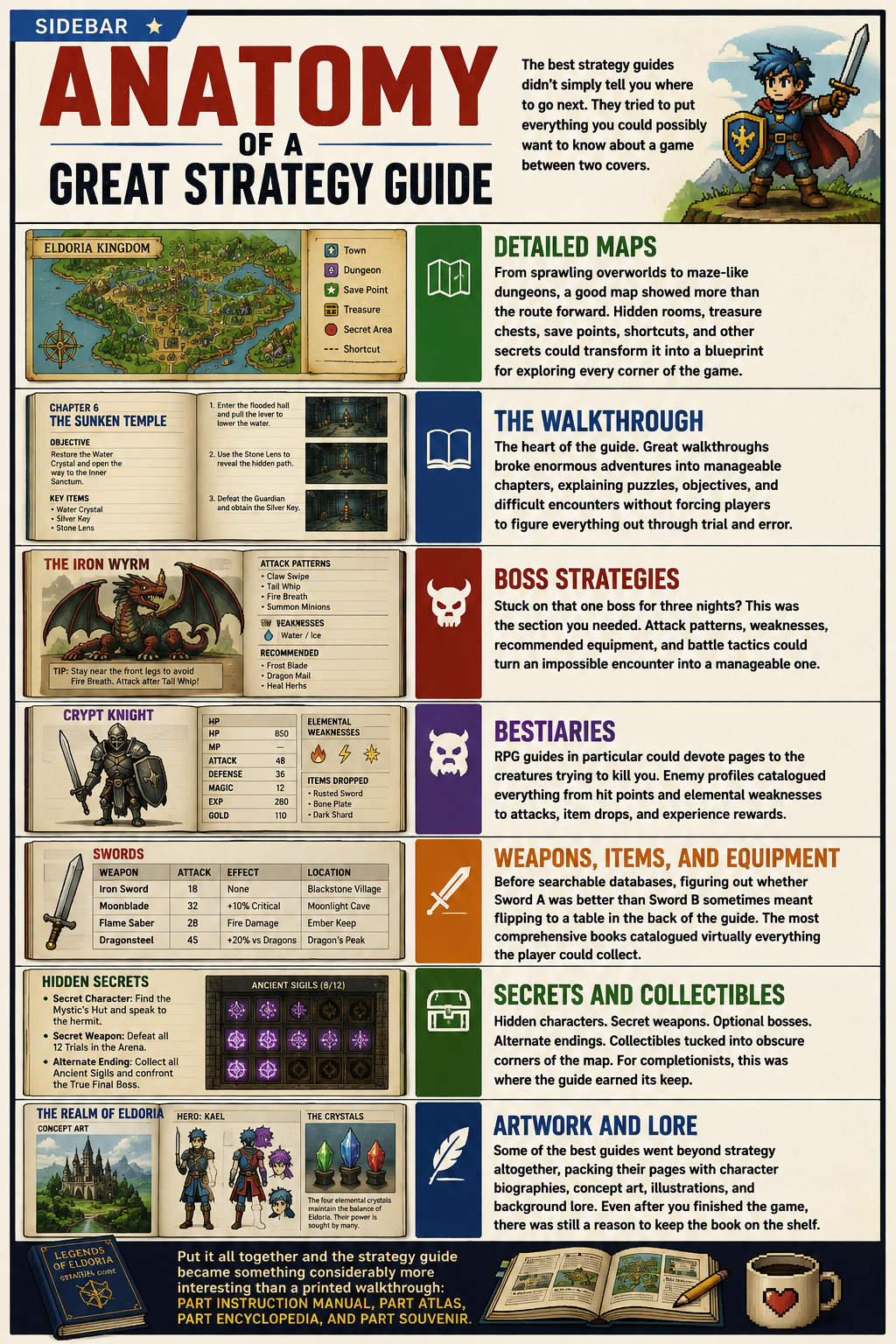
These guides often featured maps, item tables, enemy bestiaries, character profiles, and indexes, while designers made the guides browsable with tabs, icons, colour coding, and other navigation cues.
There were even special collector’s edition strategy guides, including hardcovers that would feature pull-out posters and other extras.
Flipping through a guide when you weren’t actually stuck was a joy in and of itself, because it helped enrich the world you were exploring.
Maps Were the Masterpieces
Before online walkthroughs, strategy guide maps were immensely valuable. These guides often included dungeon layouts, overworld maps, and labyrinthine RPG arenas, transforming three-dimensional game spaces into readable printed diagrams.
Of course, no discussion of maps would be complete without acknowledging the difference between the functional maps and the aesthetic ones. A functional map gave you the fastest and most effective route to your objective; an aesthetic map did so with flair and art.
Players would often annotate these maps or use them to plan routes through the game, leveraging them to avoid crossing the same screen four times on the way to the objective.
The guides for The Legend of Zelda: Ocarina of Time exemplify this trend. Dungeons are spatial puzzles, so converting something like the Water Temple into comprehensible printed maps demonstrated the craft involved in guide design.
The Guide Became Part of the Game
Players would often play the game with the book open beside them, bookmarking the current dungeon or chapter for future reference.
By keeping the guide open while playing the game, players could quickly pause to check enemy weaknesses and boss strategies, or hunt down every collectible and secret.
Guides made 100% completion feasible for ordinary players, and especially for RPGs, the guide became almost as important as the manual. In sum, using the strategy guide was its own gameplay ritual.
Pokémon created exactly the sort of information problem that guides excelled at: 150 creatures, evolutions, locations, moves, type matchups, items and labyrinthine areas. A kid wasn't necessarily consulting the guide because they couldn't beat the game; they might be trying to figure out where in Kanto to find Tauros. This demonstrates how the guide became an encyclopedia rather than merely a walkthrough.
The Spoiler Problem
Of course, video game strategy guides presented a few problems for players. The most pressing problem was the temptation to read ahead, which often led to accidentally uncovering spoilers for the end of the game. Players who read ahead would often accidentally discover bosses, characters, or locations they hadn’t yet encountered in-game.
As a result, guides evolved – attempting to separate walkthrough information from secrets in a way that would preserve game secrets.
Every player knows the internal debate: “Do I look it up, or do I keep trying?”
And some players even felt a bit of shame about using the strategy guide, viewing it as a form of cheating.
That means many players learned to live and die by one rule: You don’t turn the page until you’ve beaten the boss.
When The Guide Was Wrong
Of course, there was always the risk that the guide would be wrong.
Guides were often written according to prerelease versions of games, and if something changed prerelease, the guide wouldn’t reflect it. Last-minute changes to games would create incorrect information in the guides.
Meanwhile, translation and localization problems meant that international guides would often contain errors.
Some guides even missed key secrets or had incomplete walkthroughs, while the unofficial guides relied on imperfect information.
As a result, players would often discover things the supposedly-definitive book didn’t know.
One factor responsible for this phenomenon is the fact that guide writers often had to document enormous games under brutal deadlines, fighting against the clock to get the guide out the door. As a result, guides often had errors.
One particularly notorious example came with Prima Games’ official guide for 2011’s Mortal Kombat. The guide contained incorrect directional inputs, conflicting information, and other inaccuracies. Prima later attributed the errors to rapidly changing game builds and last-minute changes, eventually offering buyers corrected character reference cards. It was an unusually visible example of one of the fundamental problems with print strategy guides: sometimes the book had to be finished before the game was.
Strategy Guides as Expanded Worlds
Strategy guides were about more than utility – they helped create fandoms around specific games.
These guides would often contain character biographies and lore, concept artwork unavailable elsewhere, illustrations of weapons, monsters, and items, or, in premium guides, developer commentary.
Guides essentially became pseudo-encyclopedias for players’ favourite games, which is why people kept them after the walkthrough itself became obsolete.
One prime example of this was the EarthBound Player’s Guide. Nintendo packaged EarthBound with an unusually elaborate player's guide rather than treating the book as an optional accessory. Its faux-travel-guide presentation, clay-model artwork, maps and scratch-and-sniff elements made the physical guide part of the game's identity.
The Internet Killed the Walkthrough Book
All things must eventually come to an end, and that’s equally true of the video game strategy guide. GameFAQs and text walkthroughs on the Internet provided free alternatives to official guides, while forums made it easy to search for obscure answers. Wikis turned walkthroughs into collaborative and constantly-updated databases, and YouTube solved the biggest limitation of text: You could actually watch someone do the thing you were trying to do.
Smartphones also eliminated the inconvenience of having the computer in the other room, and printed guides became increasingly difficult to justify as practical tools.
These reasons are why Prima Games ended its long-running print-guide operation in 2019; this was effectively the symbolic end of the video game strategy guide’s golden age.
What We Gained – and What We Lost
Video game strategy guides didn’t disappear – they evolved. And that evolution is more complex than “Old thing good, new thing bad”.
Modern guides are now freely available on the Internet, fully searchable, updateable, and vastly more comprehensive than retro guides. Meanwhile, video walkthroughs can demonstrate techniques that print never could.
Wikis can document games in extraordinary depth, outclassing the video game strategy guide in terms of content.
But as information accessibility grew, the information itself has become fragmented between videos, Reddit posts, Wikis, articles, and search results. The physical guide offered something different: A curated, finite companion to an entire game.
The Internet may give you the answer, but the strategy guide gave you the world.
One great example of how the Internet changed the strategy guide is the Final Fantasy IX Official Strategy Guide from 2000. This guide became notorious for repeatedly directing readers to Square’s PlayOnline website for additional information, rather than printing the answers in the book.
Strategy Guides Became Collectibles
While strategy guides rarely serve their original functional purpose, they still survive alongside retro games. Complete-in-box collectors sometimes seek matching guides, with rare or premium editions commanding significant collector interest.
There’s also a nostalgia factor at play, especially for the Prima/Brady Games-era design. Guides are now being appreciated as artifacts of gaming history rather than obsolete reference books.
Closing the Book on Strategy Guides
A battered guide with a cracked spine isn’t necessarily damaged – rather, it’s evidence that someone actually used it. Notes, bookmarks, and worn pages record someone’s journey through the game.
While online walkthroughs are objectively better at delivering information, they can’t quite reproduce the feeling of finishing a game and then closing the guide beside it.
The strategy guide belonged to an era when beating a video game required two pieces of media: The game itself, and the book that taught you how to conquer it.