The Games We Never Got
A look at some of the cancelled games, abandoned sequels, vaporware, and prototypes that never made it to the commercial release stage.
Remember the game you couldn’t play?
You know the one. You discovered it as an upcoming release in a gaming magazine, and at the time, it looked incredible.
There were screenshots. A release window. Maybe even a multi-page preview describing features that sounded, at the time, revolutionary.
So you wait. And wait. And then the release date slips past. The game disappears from upcoming-release lists. Eventually, you realize it’s never coming.
Gaming history isn’t composed exclusively of the games we played. It’s also filled with the games we were promised.
For players who grew up before developers could constantly communicate through social media, cancelled games could simply disappear. Unless a magazine reported the cancellation, you might never know it happened.
Whether it’s a cancelled game, an abandoned sequel, a game that radically transformed during development, or some kind of vaporware that seemed perpetually just around the corner, there’s no shortage of video games that just never actually happened.
Some of them became footnotes in gaming history. Others became legends.
When Gaming Magazines Sold Us Games That Didn’t Exist Yet
In the pre-social media era, players often learned about upcoming game releases through non-digital means. Gaming magazines, trade show reports, promotional VHS tapes, demo discs, and retail catalogues all provided tantalizing glimpses of games still under development. And then there was word of mouth: Sometimes you had a friend who knew a developer who was working on something really cool.
Once screenshots appeared in Nintendo Power, Electronic Gaming Monthly, GamePro, or another publication, the game suddenly felt real – even if development was nowhere near finished.
Cancelled games were particularly mysterious at that point in time. Information moved slowly in the 1990s, and publishers controlled most screenshots and game footage. Development problems largely remained private, and release dates could disappear without much explanation.
There was no developer Discord, Twitter thread, or YouTube documentary explaining what went wrong. A cancelled game, therefore, could leave behind little more than a few screenshots and a paragraph in an old magazine.
These fragments gave players enough information to get excited – but not enough to know what the game actually would’ve been.
The Sequels That Vanished
Perhaps the most painful category of games we never got was the cancelled sequels to games that players had already come to love.
EarthBound 64 is a prime example. Nintendo’s long-awaited follow up to EarthBound was originally being developed for the Nintendo 64DD, and later, the standard N64.
Magazine screenshots and trade show demonstrations made it tangible, but development dragged until Nintendo cancelled the project in 2000.
Much of its underlying concept eventually resurfaced in Mother 3 for the Game Boy Advance – but the Nintendo 64 version remains one of gaming’s great alternative histories.
Another prime example is StarCraft: Ghost. Announced in 2002 and planned for console release, this action game would have allowed players to experience the StarCraft universe from an entirely different perspective. It appeared at trade shows, received extensive press coverage, changed developers, and then lingered for years before effectively disappearing.
Some of the other planned sequels that disappeared off the face of the earth include Mega Man Legends 3, Chrono Break, and Legacy of Kain: Dead Sun.
So why do cancelled sequels hurt more than other cancelled games? Because players don’t have to imagine an entirely unknown game. Instead, they can imagine another adventure in a world they already know.
Games From Another Timeline
Beyond straightforward cancellations, there’s no shortage of games whose surviving prototypes reveal radically different versions of gaming history.
Before Resident Evil 2 became the classic players know and love today, Capcom developed a substantially different version starring Leon Kennedy and Elza Walker. Titled Resident Evil 1.5, this game saw large portions completed before Capcom scrapped the project to start over.
This game’s survival through screenshots, footage, prototypes, and preservation efforts gives players a rare glimpse into a version of a famous game that effectively came from another timeline.
Another game from another timeline? Sonic X-treme for the Sega Saturn. This cancelled project was intended to properly bring Sonic into the 3D era, but it suffered from technological challenges, internal conflict, changing development approaches, and brutal working conditions. The game’s absence became especially significant because the Saturn never received the flagship 3D Sonic adventure fans came to expect.
Sometimes the importance of a cancelled game isn’t what it might have been – it’s the hole that the cancellation left behind.
The Games That Became Something Else
Now, not every “lost” game disappears completely. Sometimes, development survives by mutating into something almost unrecognizable.
One fantastic example of this trend is Rare’s Dinosaur Planet, an original N64 adventure that was going to be a unique franchise all its own. Rare later turned the project into Star Fox Adventures for GameCube, retaining substantial elements from the original concept while incorporating the existing Star Fox franchise.
The discovery and preservation of a late Dinosaur Planet build decades later allowed players to see just how much survived – and how much changed.
Another example is Rare’s Project Dream. This game began as an RPG concept before evolving dramatically during development to eventually become Banjo-Kazooie.
This raises an important philosophical question:
When does a cancelled game stop being a cancelled game and become an early version of something else?
Development history is rarely as clean as “game existed → game cancelled.”
Ideas, technology, characters, mechanics, and assets can survive long after the original project dies, perhaps sometimes finding new life as a different project.
Why Cancelled Games Become Legendary
It turns out, there’s a psychology behind our fascination with cancelled games. An unreleased game has one enormous advantage over a released game:
Nobody can prove it wasn’t going to be amazing.
A finished game has bugs, compromises, bad levels, awkward controls, disappointing reviews, and technical limitations.
But a cancelled game?
A cancelled game will always exist in its ideal form.
Players will always remember carefully curated screenshots, developer promises, magazine previews, concept art, impressive demonstrations, and features that may never have actually worked.
As a result, the imagined version of a game can become better than any realistic finished version could have been.
The Internet Resurrected Dead Games
While it may seem like these cancelled and abandoned games are no more than headstones in the graveyard of history, it turns out, the Internet and its associated preservation initiatives has radically changed the status of cancelled games.
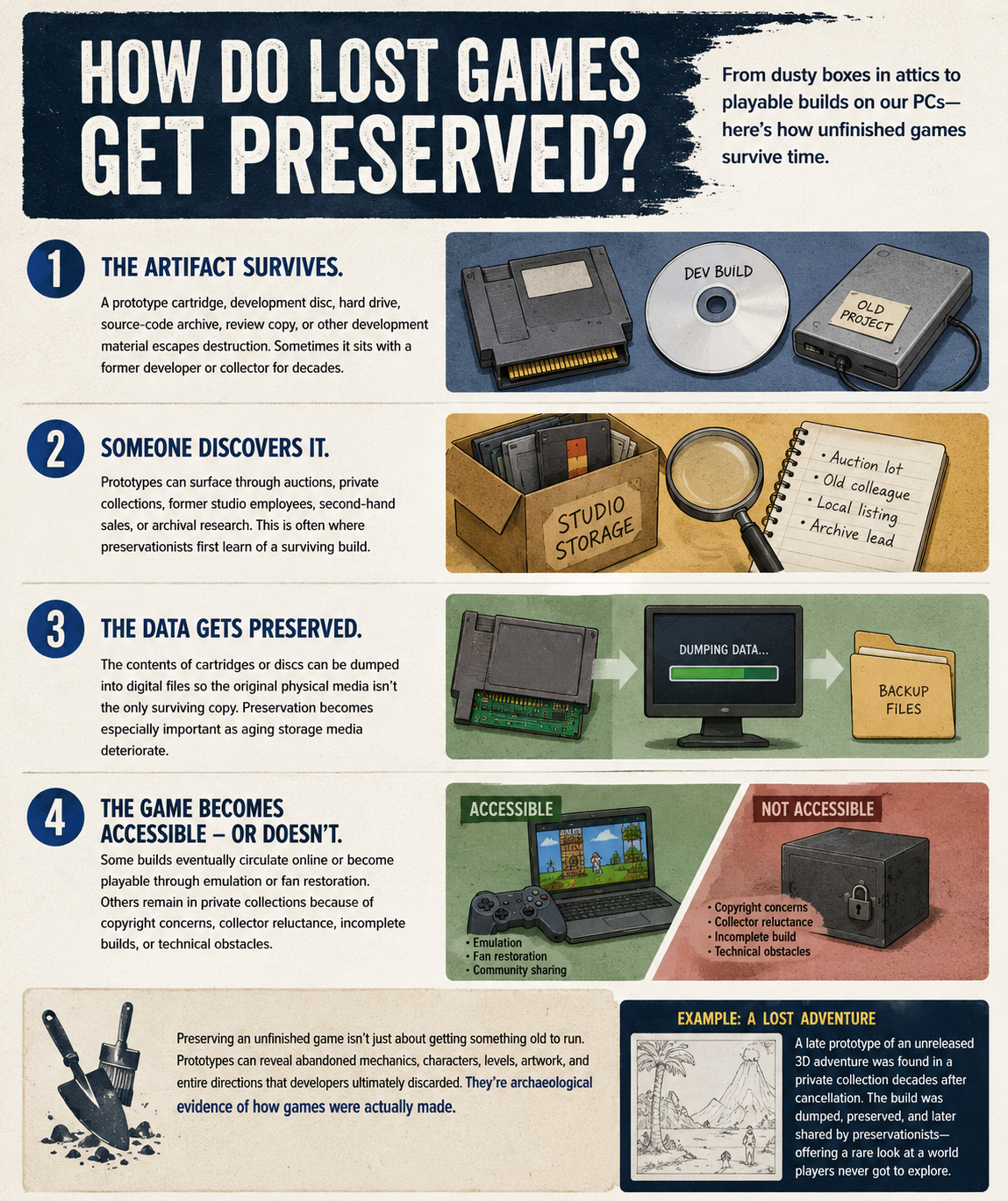
Projects once known only through grainy magazine screenshots can now resurface through prototype ROMs, development builds, source-code discoveries, former developer archives, preservation groups, YouTube footage, fan restoration projects, and interviews conducted decades after the fact.
Games that were once effectively myths can suddenly become playable. This creates an unusual experience: Playing something you were never supposed to play.
But preservation also complicates the mythology. Sometimes, preservation unveils an ambitious lost masterpiece. Other times, it reveals exactly why the game was cancelled.
Either outcome makes the historical record richer.
Gaming’s Ghost Library
Somewhere in an old magazine issue in your closet, there’s a screenshot of a game that promised an adventure nobody ultimately experienced.
Yet, that game didn’t completely disappear. It survived in memories, prototypes, magazine pages, development stories, screenshots, and speculation.
Cancelled games remind us that gaming history isn’t simply a shelf containing everything that shipped.
Behind that shelf is an enormous invisible library of experiments, failures, abandoned ideas, and alternate-universe versions of familiar franchises.
Some deserved to disappear.
Some might have become classics.
We’ll never know either way.
And that’s why, decades later, we’re still fascinated by the games we never got.