The Great Memory Card Crisis
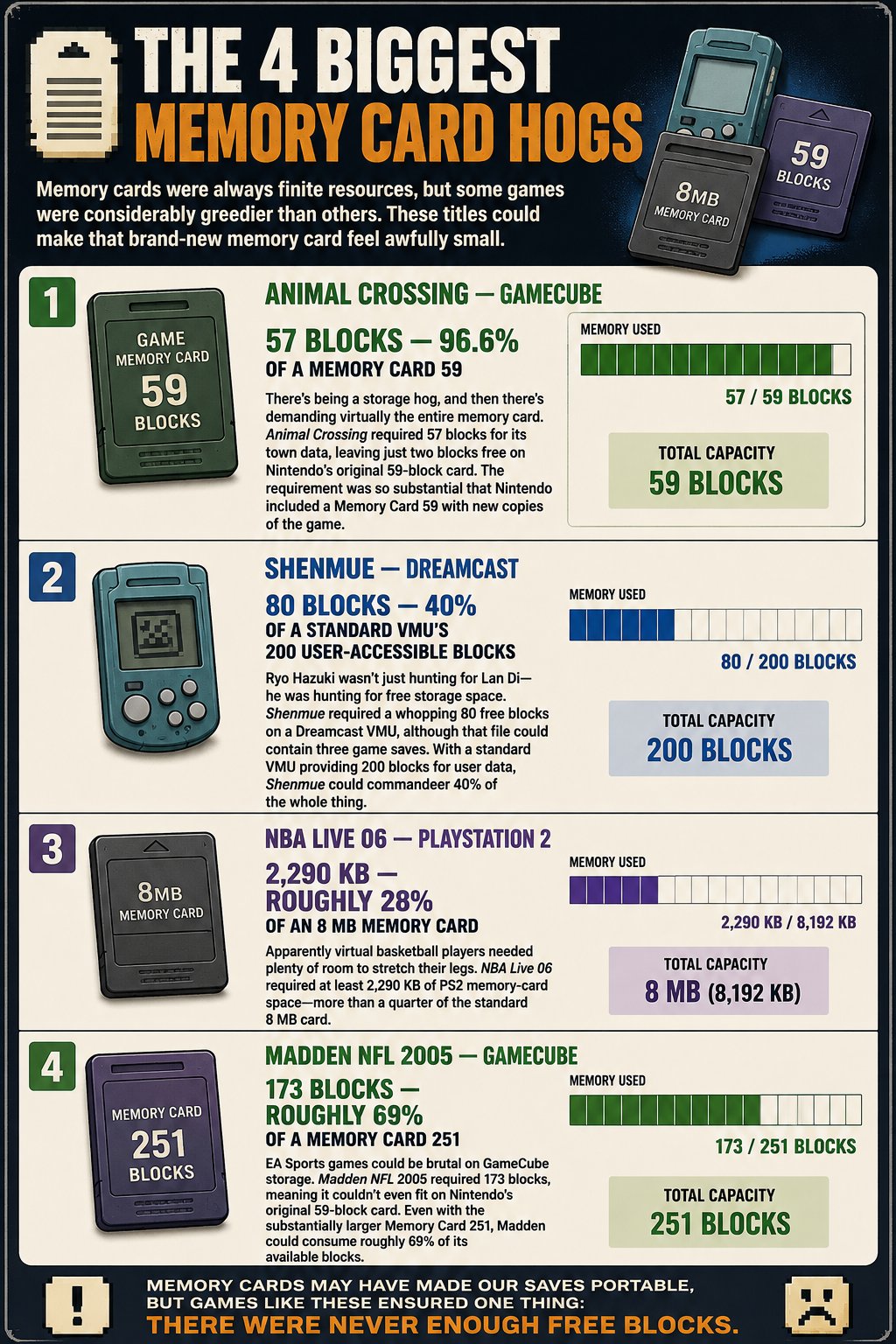
A retrospective on the days when there were never enough free blocks.
Every PlayStation-era gamer remembers the same feeling of dread – you boot up a new game, try to save, and quickly discover that your memory card is full.
You now have a terrible decision to make.
Will you erase your Final Fantasy VII save? Your completed Resident Evil file? Your brother’s Gran Turismo progress? The game you haven’t touched in six months but are absolutely convinced you’ll return to someday?
Something has to go.
Before we had hard drives, cloud saves, and virtually unlimited storage, saving a game itself was a form of resource management.
Before Memory Cards: When Saving Wasn’t Guaranteed
Nowadays, we have memory cards, hard drives, and cloud save systems that enable us to save just about everything. But back in the 1990s and early 2000s, these things were far more technologically limited than they are today.
Instead, we had password-based save systems, battery-backed cartridge saves, and some games with no save functionality whatsoever. In that case, you had to leave the console running overnight and return to your game the next day.
Cartridge-based saving made storage largely invisible to players. If a game supported battery-backed saves, you could simply save your progress directly to the cartridge.
But when the industry began embracing CD-based consoles, save data needed somewhere to live other than on the game cartridge itself.
Enter: The memory card.
The PlayStation Makes Saving a Physical Object
The original PlayStation is the definitive example of saving as a physical object. The console’s memory card had 15 usable blocks of memory, with different games consuming different numbers of blocks. The system’s memory-card manager would display the save icons on the screen, so you could see how much spare memory you had.
But these memory cards were sold as separate accessories – you had to buy them independently of the PlayStation itself. While that was a negative at the time, the notion of the memory card created a strange novelty where you could physically carry your saves somewhere else, making game progress tangible. Your Final Fantasy, Metal Gear Solid, or Tony Hawk career wasn’t merely “on the console” – it lived in a small plastic rectangle that you could take with you.
The Great Memory Card Triage
Okay, so memory cards were an innovative leap forward in save system functionality. But what happens when your memory card gets full? What has to go?
There’s a bizarre mental calculus involved in figuring out what to delete. Firstly, you’d have to consider how recently you played a game. Secondly, you’d have to think about how many hours of effort are invested in the save.
Then you’d have to think about whether you could realistically recreate the save. And whether the game is actually finished. Or if the save belongs to someone else, like your little brother.
And of course, there was always the frustration of asking, “Why does this game need THREE WHOLE BLOCKS?”
Players would often have to maintain multiple memory cards at the same time, potentially developing their own organizational system. For instance, you might have one card for RPGs, one for sports and racing games, and another for miscellaneous saves.
In a way, deleting a save felt weirdly permanent…because it was.
The Household Memory Card Cold War
Of course, memory cards weren’t just technological objects. They also represented important shared resources in households with siblings or shared consoles.
In these kinds of situations, memory cards could become hotly contested territory. Maybe your brother deleted your save to make room for his own. Maybe someone overwrote the wrong file.
Siblings would often argue over whose games deserved blocks, and would work hard to keep their personal memory cards separate. If you took your memory card to a friend’s house, there was always a risk that you might accidentally leave it there.
Memory cards weren’t just storage devices - they were personal possessions.
PlayStation Wasn’t Alone in the Memory Card Race
Sony may have popularized memory cards, but other console manufacturers had their own versions.
The Nintendo 64 Controller Pak was one example. Many N64 games were saved to cartridge, but others relied on the Controller Pak, which became another finite pool of save space that players had to manage.
Meanwhile, the Dreamcast VMU was a prime example of SEGA turning memory cards into something much stranger. The Dreamcast VMU featured a screen, buttons, minigames, and portable functionality, and it demonstrated how saves could become even more visibly tied to a physical device.
And then there were the GameCube memory cards. Memory cards like the 59 and 251 showed how Nintendo literally marketed memory capacity by blocks, and some games were notorious for being storage hogs.
Limited removable save storage was a huge part of gaming culture for an entire generation of players.
When Memory Cards Started Getting Absurd
Save files and memory cards grew together. The PlayStation 2 still relied heavily on its 8 MB memory cards, but at that point in gaming history, the concept of memory cards started to feel restrictive. The most well-documented example is Gran Turismo 4. The manual for that game lists 2,500 KB for game data, which is roughly 30% of an entire standard 8 MB PS2 memory card – just for one game.
Players would often have to buy additional memory cards, sometimes including third-party high-capacity cards, in order to manage their saves. This often came with the fear of unreliable third-party storage accidentally erasing saves. Meanwhile, games were getting bigger, and were consuming increasingly large chunks of space on memory cards.
By the time the Xbox arrived with its internal hard drive, it demonstrated an increasingly attractive alternative to memory cards. The memory card crisis was ultimately a technological problem waiting to be eliminated.
The Resolution of the Memory Card Crisis
The birth of the Xbox 360 and the advent of the PlayStation 3 forever changed how we save games. Internal hard drives became the new standard, and eventually, gamers got hundreds of gigabytes of local storage, cloud saves, automatic synchronization, and profiles tied to online accounts.
As a result, running out of save-game space specifically became unusual. Today, you might delete a 100GB game because your SSD is full – but agonizing over whether to delete a 40-hour RPG save to make room for another save is a thing of the past.
What We Lost When the Memory Card Crisis Resolved
Modern save systems are objectively more convenient than those of the 1990s and early 2000s, and few people genuinely want to return to 15-block memory cards.
But when save files stopped being physical, something disappeared into the digital ether with them.
Memory cards could become little time capsules. Plug in a card you haven’t touched in 20 years, and there you’ll find all of your saves – Resident Evil 2, Tony Hawk’s Pro Skater 2, Final Fantasy VII, and more.
These tiny files aren’t impressive technologically, but they do represent dozens or even hundreds of hours of your childhood.
One Save to Never Delete
Once upon a time, starting a new game required deciding which piece of your gaming history you were willing to erase.
We don’t have to make that choice anymore, and that’s unquestionably an improvement.
But anyone who lived through the memory card crisis probably remembers staring at those blocks, desperately searching for something expendable.
The memory card didn’t just store our progress. For a while, it forced us to decide which progress mattered. And that’s a part of gaming history that should never be deleted.