Before YouTube: How Gamers Shared Secrets
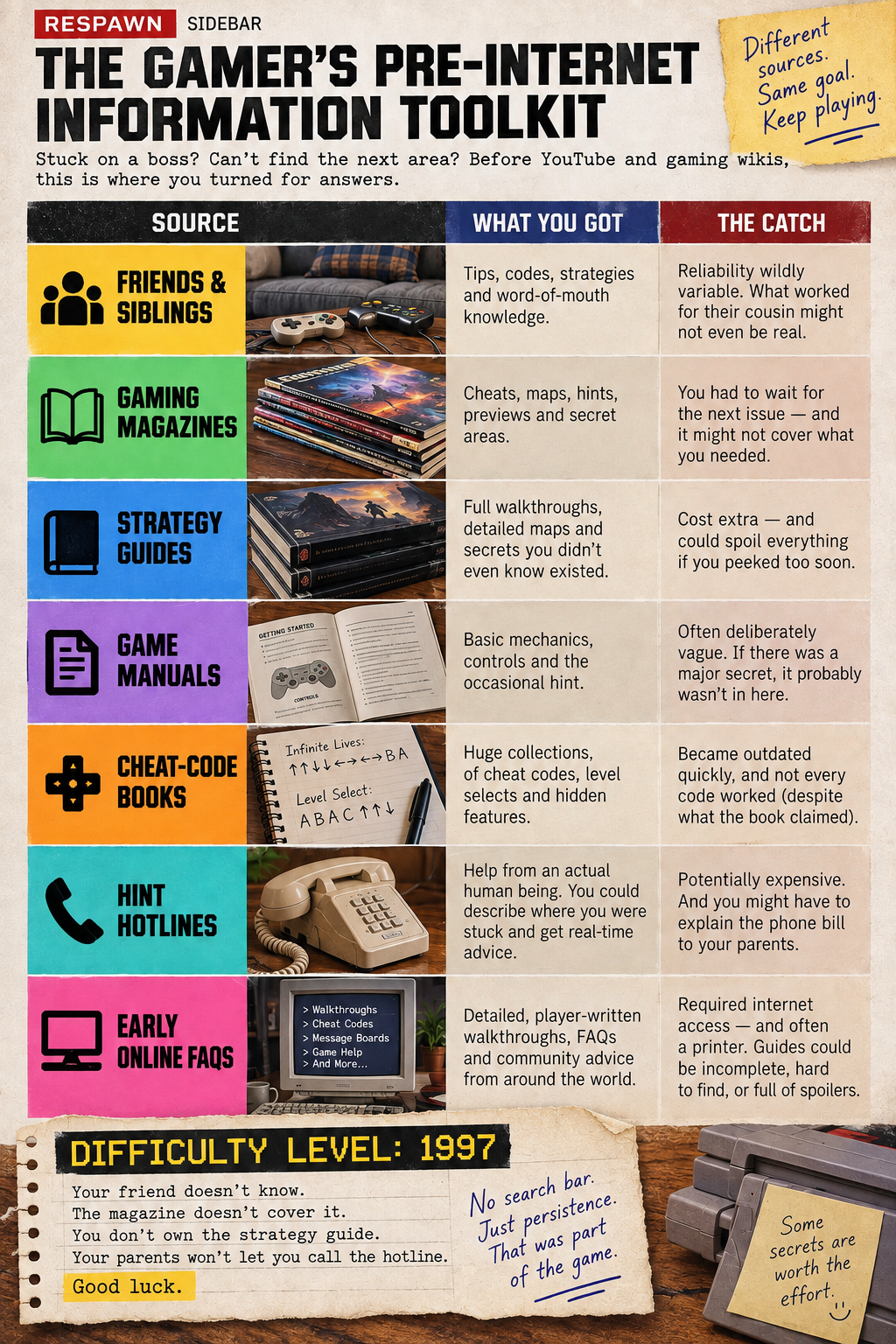
Before walkthrough videos and gaming wikis put every answer a click away, video game knowledge travelled through magazines, playground rumours, cheat-code notebooks, strategy guides, and the occasional very expensive phone call.
There was a time when getting stuck in a video game meant actually being stuck.
Maybe there was a boss you couldn’t beat. Maybe you had no idea where to go next. Maybe you’d spent the better part of an afternoon searching for an item that seemingly didn’t exist.
Or maybe your friend told you there was a secret character hidden somewhere in the game, and all you had to do was complete a ludicrous sequence of increasingly improbable tasks to unlock them.
Today, the solution is obvious: look it up.
Search the game on YouTube and there’s probably a walkthrough showing exactly what to do. Search Google and you’ll find a wiki documenting every item, enemy, secret room, alternate ending, and obscure piece of trivia. If those fail, Reddit has probably answered your question three times already.
But for players who grew up before the internet became ubiquitous, gaming knowledge worked differently.
Secrets travelled slowly. They passed from player to player, magazine to magazine, and schoolyard to schoolyard. Some were written down. Some were carefully researched. Others mutated somewhere between “my cousin says” and “everyone knows.”
It was inefficient.
It was unreliable.
And it was glorious.
The Playground Network
Before gamers had online communities, they had recess.
The playground was one of gaming’s earliest social networks. If someone figured out how to reach a secret area, beat a difficult boss, or perform a fatality in Mortal Kombat, that information didn’t stay secret for long.
You told your friends.
They told their friends.
By lunch, half the school knew.
Information moved through sleepovers, arcades, school buses, neighbourhood friendships, siblings, cousins, and anyone else who happened to have the same game.
There was just one problem: nobody was fact-checking any of it.
A legitimate secret and something a kid completely invented could travel through exactly the same network. Sometimes the rumour became more convincing as it spread. Someone claimed they’d actually seen it. Someone else had a cousin who definitely did it. Another kid knew somebody whose older brother worked at Nintendo.
Gaming developed its own folklore.
Few franchises demonstrate this better than Pokémon. Early games were filled with secrets that felt just plausible enough to make almost anything believable. Players traded elaborate stories about hidden Pokémon and inaccessible areas, with perhaps no rumour more famous than the supposed Mew hiding beneath a truck near the S.S. Anne.
Other games produced their own legends. Players searched for hidden characters that didn’t exist, impossible alternate endings, secret levels and methods for resurrecting characters the story had very deliberately killed.
Without an easy way to verify the information, the possibility remained.
And sometimes possibility was enough.
When Magazines Were Google
Of course, playground intelligence wasn’t the only option.
If you wanted something slightly more reliable, you could wait for the next issue of your favourite gaming magazine.
Publications such as Nintendo Power, Electronic Gaming Monthly and GamePro weren’t simply places to read reviews and previews. They were information repositories.
Pages were packed with maps, passwords, cheat codes, boss strategies, secret areas and tips for getting through particularly difficult sections of games.
For a stuck player, finding the right magazine could feel like discovering forbidden knowledge.
There was also something fundamentally different about the speed at which that knowledge arrived.
If you encountered a problem today, you can have the answer in seconds. In the magazine era, the solution might not appear until next month—assuming it appeared at all.
That delay changed how people played.
You tried again. You experimented. You searched every suspicious wall. You asked friends. You swapped theories. Maybe you eventually figured it out yourself.
And when the magazine finally arrived, it wasn’t necessarily disposable reading. Issues were kept beside consoles, folded open to important pages, passed among friends and revisited whenever somebody needed a particular code or strategy.
Gaming information was physical.
You could literally lend someone the answer.
Cheat Codes Were Social Currency
Few pieces of gaming knowledge carried more playground value than a good cheat code.
The Konami Code. Infinite lives. Level selects. God modes. Debug menus. Secret characters. Button combinations that had to be entered at exactly the right moment.
Knowing the right sequence could transform a game.
And because these codes weren’t always easy to find, players created their own archives.
Maybe yours was a notebook.
Maybe it was the back page of a school agenda.
Maybe it was a scrap of paper tucked inside a game case, covered in increasingly illegible handwriting.
Maybe you copied a code from a friend who copied it from another friend who got it from a magazine six months earlier.
A sequence of buttons could become valuable information.
Up. Up. Down. Down. Left. Right. Left. Right.
You didn’t need to know why it worked. You just needed to know that it did.
There was a ritual to it: carefully entering the sequence, watching the screen for some indication that you’d done it correctly, then feeling like you’d somehow outsmarted the game itself.
Even better was being the person who knew the code when nobody else did.
Before achievements, follower counts and online rankings gave players new ways to measure status, sometimes gaming credibility was as simple as knowing something your friends didn’t.
The Strategy Guide Era
For players who wanted something more comprehensive than a magazine, there were strategy guides.
Companies such as Prima and BradyGames produced thick books dedicated to individual games, while Nintendo published its own line of Player’s Guides.
These weren’t collections of scattered tips. They promised something far more powerful: knowledge of the entire game.
Maps. Item locations. Character statistics. Boss strategies. Side quests. Secrets. Walkthroughs.
Everything was there.
Or at least, everything the guide’s authors knew about.
Buying one could fundamentally change the experience of playing a game. Suddenly the enormous RPG you’d been stumbling through had structure. That hidden item you never would have found was marked on a map. That boss who had destroyed you six times had a weakness.
But strategy guides also introduced a dilemma that still exists today.
How much do you actually want to know?
There was always the temptation to peek ahead. Just one page. Just enough to get past this part.
Then another.
Then maybe another.
The battle between wanting help and wanting to discover something yourself didn’t begin with YouTube walkthroughs.
We’ve been losing that battle for decades.
When Getting Stuck Meant Making a Phone Call
And if the magazines, friends and strategy guides couldn’t save you, there was another option.
You could call Nintendo.
Nintendo launched its game-counselling hotline in 1987, employing gameplay counsellors who helped players through difficult sections of Nintendo games. Counsellors had access to extensive reference material—including binders containing notes, maps and solutions—that they could consult while talking players through their problems. The service survived until 2005, by which point the internet had made paying for game advice increasingly difficult to justify.
Think about how strange that sounds now.
You were stuck in a video game, so you picked up a telephone and spoke to another human being whose job was to tell you what to do next.
For younger players, there was another obstacle involved: whoever paid the phone bill.
Nintendo eventually operated the service through a toll number, which meant asking Mom or Dad for permission before making a call—or discovering later that perhaps you should have.
Still, the existence of gameplay counsellors says something important about the era.
Game information was valuable enough that people would literally pay to access it.
Today, millions of walkthroughs are available for free.
Back then, the answer could be on the other end of a phone line.
And Sometimes the Experts Lied Too
Magazines were more reliable than playground rumours.
Usually.
One of gaming’s greatest urban legends demonstrates what happened when the authority figures decided to join the fun.
The arcade version of Street Fighter II included a notoriously confusing victory quote from Ryu: “You must defeat Sheng Long to stand a chance.”
“Sheng Long” wasn’t actually a character. The line resulted from a mistranslation involving Ryu’s Shoryuken.
But players didn’t necessarily know that.
Who was Sheng Long?
Could you fight him?
Was he hidden somewhere in the game?
Then, in April 1992, Electronic Gaming Monthly poured gasoline on the rumour. The magazine published an April Fool’s joke claiming Sheng Long really was a secret boss and provided an absurdly difficult series of steps supposedly required to encounter him. Players tried anyway. The hoax became one of the most famous pieces of video game folklore of the era.
It was the perfect environment for the story to flourish.
There was no YouTube video debunking it.
No wiki page immediately labelling Sheng Long a hoax.
No searchable Reddit thread containing 400 comments explaining what had actually happened.
There was a magazine.
There were screenshots.
There was a rumour people already wanted to believe.
So they tried it.
Of course they did.
The Internet Arrives
Eventually, gaming’s information network began moving online.
Early internet communities offered something unprecedented: players who would never meet in person could pool their knowledge.
Usenet groups, message boards, IRC channels, fan sites and online FAQs expanded the playground network to a global scale.
And then there was GameFAQs.
Launched by Jeff Veasey in November 1995 as the Video Game FAQ Archive, the site began with roughly 100 guides. By the following year, it had grown dramatically and adopted the GameFAQs name.
For an entire generation of players, GameFAQs became synonymous with getting unstuck.
Its enormous text walkthroughs were artifacts of a particular period of internet history: plain text, ASCII maps, elaborate tables of contents, spoiler warnings and guides written by people who had spent an astonishing amount of time documenting a game simply because they wanted to help other players.
You might print the walkthrough.
You might keep the family computer running in another room and travel back and forth between it and the console.
You might scribble the important part onto a piece of paper.
The information was online now, but the experience still retained some of its older character.
Answers weren’t necessarily instant. Guides could be incomplete. Rumours still circulated. Not every game had been comprehensively documented.
The mystery was disappearing.
But it wasn’t gone yet.
Then YouTube Changed the Question
Today, video games may be among the most thoroughly documented entertainment products ever created.
Major releases can have detailed wikis almost immediately. Players upload boss fights, endings, Easter eggs and collectible locations to YouTube. Communities collectively dissect games. Dataminers can sometimes uncover secrets before ordinary players would ever have a realistic chance of finding them naturally.
That accessibility is overwhelmingly useful.
Few people genuinely want to spend three weeks wandering around because they missed an obscure doorway six hours earlier.
And there was nothing inherently superior about spending your allowance on a strategy guide or desperately hoping next month’s magazine contained the answer you needed.
But instant access to information changed something about the relationship between players and secrets.
Once, hearing about something strange in a game created a question:
Is that actually real?
You might spend days trying to find out.
Now the question is different:
Do I want to look it up?
A playground rumour can be verified before recess ends. A supposed secret character can be disproven with a search. If someone claims there’s a hidden room behind a wall, somebody somewhere has probably uploaded footage of it.
We gained certainty.
We lost a little mystery.
The Secret Was Sharing the Secret
Nobody should romanticize being hopelessly stuck.
Old games could be cryptic. Rumours wasted countless hours. Magazines weren’t free. Strategy guides weren’t always accurate. And explaining to your parents why a video game hotline appeared on the phone bill probably wasn’t anyone’s favourite childhood memory.
But the friction surrounding gaming information created something interesting.
Knowledge became social.
The important part wasn’t always discovering the cheat code.
Sometimes it was being the person who showed it to someone else.
It was the friend who knew how to beat the boss.
The older sibling who showed you the hidden level.
The magazine somebody brought to school.
The handwritten list of fatalities.
The strategy guide passed around until the cover fell off.
The completely fabricated story that everyone believed because somebody’s cousin supposedly saw it happen.
Today, gaming secrets are information.
Back then, they were stories.
And long before walkthroughs became content, those stories were gaming’s folklore.