The Rise and Fall of Local Multiplayer
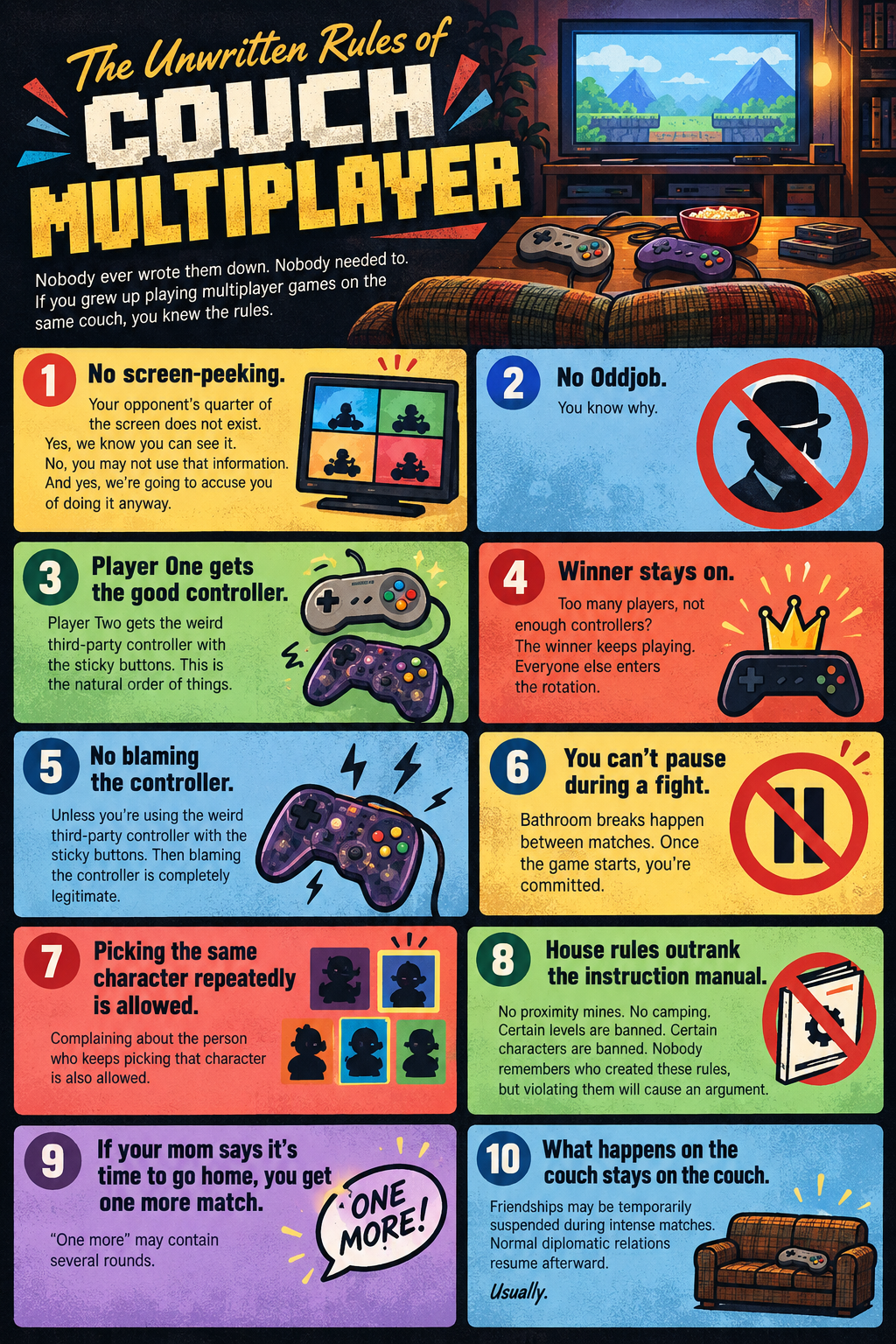
When multiplayer moved online, gaming gained the entire world. But we lost something when Player Two went home.
There was always one friend who looked at your side of the screen.
You knew it. They knew it. Everyone else in the room knew it. But unless you caught them physically turning their head toward your corner of the TV, there wasn't much you could do about it.
So you kept playing.
Four people might be squeezed onto a couch meant for three. Someone else was sitting cross-legged on the floor. Controllers stretched across the room. Empty pop cans and chip bags accumulated on the coffee table. And when somebody won, everybody knew immediately because the winner was celebrating three feet away from you.
For years, this was multiplayer gaming.
Before broadband connections, matchmaking systems, Discord servers and online subscriptions became ordinary parts of gaming, playing with friends usually required something considerably more complicated than clicking "Join Game."
Your friends had to actually come over.
Multiplayer wasn't just something happening inside the game. It was happening in the room.
And somewhere along the way, that stopped being the default.
When Player Two Sat Beside You
Local multiplayer is almost as old as video games themselves.
Pong was fundamentally a two-player experience. Atari's Combat pitted two players against each other in tanks and airplanes. Arcades were filled with games designed around competition, cooperation, or the simple pleasure of watching somebody else play while waiting for your turn.
As games moved into homes, multiplayer followed them.
Early consoles weren't capable of connecting players across cities or continents. If you wanted another human opponent, you needed another human.
Preferably one within controller-cable distance.
By the 16-bit era, that limitation had become one of gaming's greatest strengths.
Games such as Street Fighter II and Mortal Kombat turned living rooms into miniature arcades. NBA Jam gave players absurd two-on-two basketball. Super Mario Kart transformed innocent go-kart racing into an excuse to destroy friendships with turtle shells.
Then there were cooperative games.
Contra. Streets of Rage. Final Fight. Secret of Mana.
Instead of competing against the person sitting beside you, you could work together.
Either way, multiplayer was inherently social because playing multiplayer required another person to physically be there.
There were no friends lists.
There was just your friend.
The Golden Age of the Second Controller
By the 1990s, owning a second controller was practically mandatory.
The controller itself became part of the social hierarchy.
Every household seemed to have “the good controller” and “the bad controller”. The good one came with the console. The bad one was purchased later and might have been manufactured by a company nobody had ever heard of.
Player One got the good controller.
Your friend got the translucent purple monstrosity with the slightly sticky D-pad.
Those controllers represented something larger about gaming during this era: consoles weren't necessarily solitary devices.
They were gathering places.
Friends came over specifically to play games. Siblings competed against each other. Parents occasionally got dragged into races. Sleepovers could revolve around a single cartridge.
You didn't need everybody to own the game.
You didn't even need everybody to own a console.
One person owned the hardware. One person owned the game. Everybody played.
Then Nintendo put four controller ports on the front of the Nintendo 64.
And things got serious.
Four Controller Ports Changed Everything
Four-player gaming existed before the Nintendo 64. Accessories such as the Super Multitap allowed several players to crowd around games on earlier consoles.
But the N64 made four-player multiplayer feel fundamental.
Those four controller ports were right there on the front of the machine.
No adapter required.
Developers took advantage.
Mario Kart 64 let four people race simultaneously.
Mario Party turned board-game night into an elaborate exercise in betrayal.
Super Smash Bros. answered questions nobody knew they needed answered, like whether Kirby could beat Pikachu in a fight.
And then there was GoldenEye 007.
For a generation of players, GoldenEye became practically synonymous with multiplayer gaming.
Four players. One television. Split screen.
You selected a map, chose your weapons and spent the next several hours hunting your friends while simultaneously pretending you weren't looking at their quarter of the television.
Entire systems of etiquette emerged.
No Oddjob.
No screen-peeking.
No camping.
No proximity mines in ridiculous places.
Whether anyone actually followed those rules was another matter.
GoldenEye wasn't the only game creating these experiences. Perfect Dark, Mario Kart 64, Mario Party, Super Smash Bros. and countless sports and racing games turned the N64 into a social machine.
The PlayStation and Dreamcast offered their own multiplayer experiences. Later, the PlayStation 2, GameCube, and original Xbox carried couch multiplayer into another generation.
Halo became another landmark.
Four-player split-screen was already fun.
Connect multiple Xbox consoles together, however, and suddenly an entire room—or several rooms—could become a battlefield.
Which brings us to perhaps the most gloriously inconvenient form of multiplayer ever invented.
The LAN Party
PC gamers had their own version of couch multiplayer.
It just required significantly more upper-body strength.
Going to a LAN party meant hauling your computer somewhere.
Not a laptop.
Your computer.
Tower. Keyboard. Mouse. Cables. Speakers or headphones. And, during the golden age of LAN gaming, a CRT monitor roughly the weight of a neutron star.
Players transported entire computer setups into basements, bedrooms, community halls, and university dorms because playing together was worth the inconvenience.
Games such as Doom, Quake, StarCraft, Warcraft III and Counter-Strike flourished in this environment.
A LAN party could involve hours of setup before anyone actually played anything.
Somebody's computer couldn't see the network.
Somebody forgot a cable.
Someone had a completely different version of the game.
Eventually, through technical knowledge, stubbornness, or divine intervention, everything worked.
And then everyone played until an irresponsible hour of the morning.
The important part wasn't simply that these games supported multiplayer.
Players were willing to physically transport expensive computers across town because playing in the same room mattered.
Then the internet made all of that unnecessary.
Then the Internet Got Good
Online multiplayer wasn't invented in the 2000s.
People had been playing games over networks, bulletin-board systems, and the internet for years. PC gamers in particular were already accustomed to playing against people who weren't physically nearby.
But during the 2000s, online gaming became increasingly accessible to mainstream console players.
Broadband internet spread.
The Dreamcast included a modem.
Sony introduced online functionality for the PlayStation 2.
Microsoft built Xbox Live around a unified online service.
Eventually, connecting a console to the internet stopped feeling like an advanced feature and started feeling normal.
And online multiplayer solved an enormous problem.
Your friends didn't have to come over anymore.
They could be across town.
They could be across the country.
They could be on another continent.
You could turn on your console at midnight, enter matchmaking and find people ready to play.
Games weren't limited to four people because four controllers were the most you could reasonably attach to a television. Multiplayer matches could involve dozens of players.
For people whose friends had moved away, online gaming could actually preserve relationships that local multiplayer couldn't.
There was nothing inherently worse about this new form of multiplayer.
In many ways, it was miraculous.
But it changed what developers—and players—expected multiplayer to look like.
The Slow Disappearance of Split Screen
As online multiplayer became standard, local multiplayer increasingly became optional.
Why divide one television into four tiny windows when every player could have an entire screen?
Why optimize a game to render multiple viewpoints simultaneously when players could connect separate machines instead?
Why build a multiplayer experience around four people in one room when online infrastructure could connect millions?
The industry's priorities shifted.
Big-budget multiplayer increasingly revolved around accounts, servers, matchmaking, downloadable content, progression systems, and persistent online communities.
The second controller didn't disappear.
It just became less important.
For players who grew up during the height of couch multiplayer, the change could be surprisingly noticeable.
A friend could come over, look at your collection of games and ask the once-unnecessary question:
"Which of these can we play together?"
Sometimes, the answer wasn't many.
What We Lost When Player Two Went Home
Online multiplayer gave gaming something extraordinary: distance stopped mattering.
But removing distance also removed proximity.
And proximity had been doing more work than we realized.
When your friend beat you in Mario Kart, you could see their expression.
When somebody landed an absurd shot in GoldenEye, the entire room erupted.
When your co-op partner died, you didn't hear their reaction through a headset. They were sitting beside you.
Trash talk didn't travel through a microphone.
It travelled approximately four feet.
Even people who weren't playing could participate.
Someone waiting for a controller could watch the match. Friends could drift in and out. Someone could hand over their controller when they got tired.
The boundary between "playing video games" and "hanging out" was blurry.
Sometimes the game wasn't even the point.
The point was that four people were spending Saturday night together and Mario Kart happened to be what their hands were doing.
Local multiplayer also had a beautiful simplicity.
One console.
One television.
One copy of the game.
Several people.
Modern online gaming can connect vastly more players, but each participant often needs their own hardware, their own copy of the game, their own account and potentially their own subscription.
Online gaming removed the geographical barrier.
In some ways, it created new barriers in its place.
Local Multiplayer Never Actually Died
Of course, reports of couch multiplayer's death have been greatly exaggerated.
Nintendo in particular never abandoned the idea that consoles could be social devices.
The Wii practically built its identity around putting people in the same room. Wii Sports became the rare game that could convince parents, grandparents, and people who didn't consider themselves gamers to pick up a controller.
The Switch pushed the concept even further.
Its detachable Joy-Con controllers effectively turned the ability to play together into part of the hardware's design.
Meanwhile, indie developers helped spark a local multiplayer renaissance of their own.
TowerFall turned a simple archery battle into a wonderfully chaotic competition.
Overcooked discovered that cooperative cooking could produce levels of panic normally associated with emergency evacuations.
Gang Beasts made simply controlling your character part of the joke.
Ultimate Chicken Horse turned platforming into competitive sabotage.
Cuphead offered old-fashioned two-player cooperation.
Teenage Mutant Ninja Turtles: Shredder's Revenge brought the arcade beat-'em-up experience back to modern hardware.
Even larger franchises occasionally remind us how powerful local play can be.
Because there is one feature online multiplayer still can't replicate perfectly:
The other player being there.
The Couch Is Still Waiting
Gaming didn't make a mistake by moving online.
Online multiplayer allowed friendships to survive distance. It created enormous communities. It allowed players to find competition whenever they wanted it. It enabled games that would have been technologically impossible during the heyday of the Nintendo 64.
We gained something extraordinary.
But we also changed the meaning of the word "multiplayer."
Today, multiplayer might mean logging into a server populated by thousands of people.
Once, it meant somebody knocking on your door carrying a controller.
Maybe that's why local multiplayer still feels special when a game embraces it.
It isn't really nostalgia for split screens.
Nobody genuinely misses trying to aim at something while playing GoldenEye on one quarter of a 27-inch CRT.
What we miss is everything surrounding that tiny screen.
The sleepovers.
The pizza.
The arguments.
The tournaments nobody organized.
The friend insisting they weren't looking at your screen when they absolutely were.
The controller getting passed across the couch.
The moment everyone in the room started laughing at exactly the same time.
The technology was never the thing that made local multiplayer special.
It was the person sitting next to you.