How Gaming Magazines Shaped a Generation
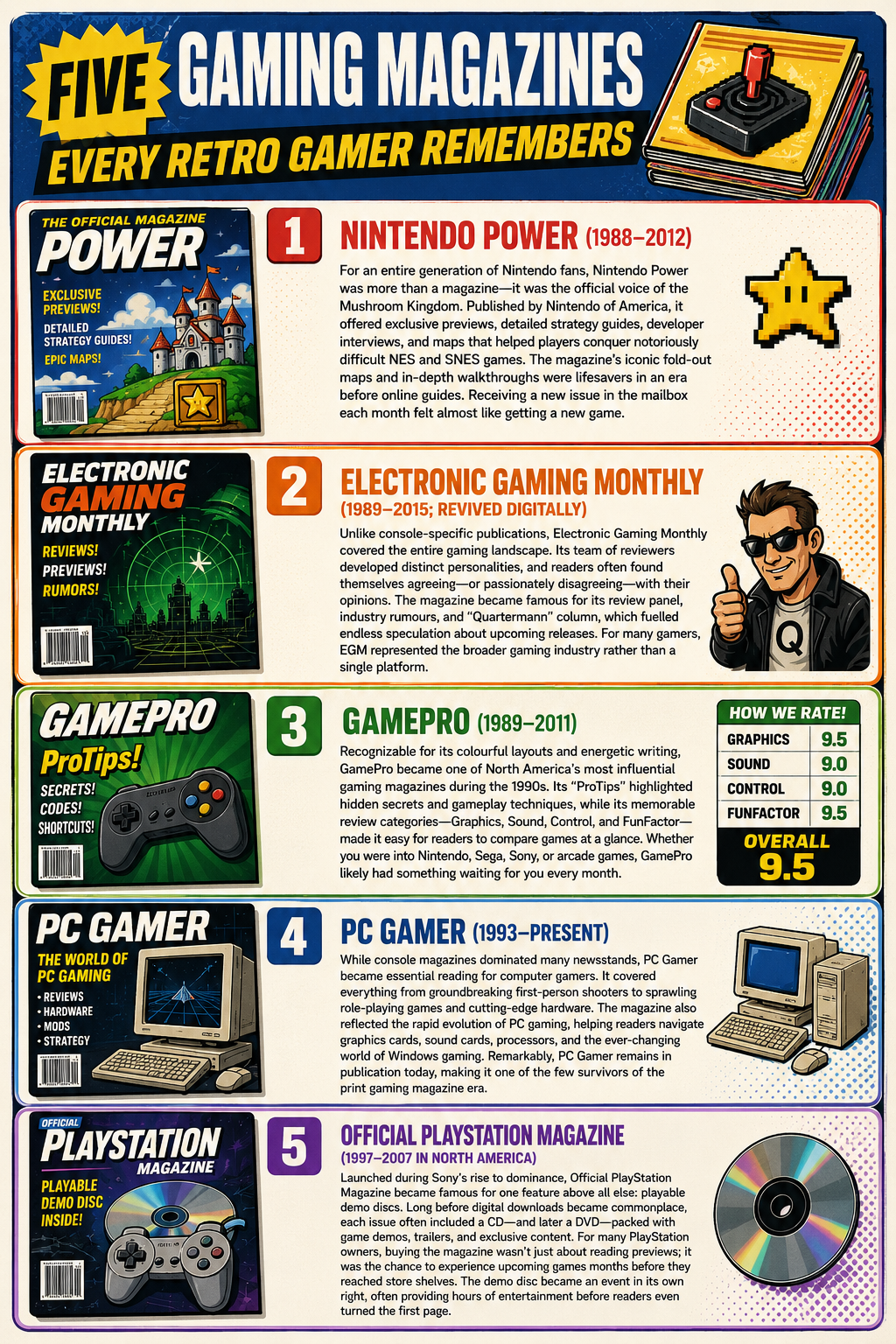
And why they still hold a special place in the hearts of retro gamers.
Before YouTube, Twitch, Reddit, and gaming websites, we had magazines. For millions of players all over the world, gaming magazines weren’t just sources of news – they were guides, teachers, tastemakers, and gateways into gaming culture.
Gaming magazines helped create the culture surrounding video games that we now know and enjoy. They influenced what we played, how we played, and how we connected to other gamers.
Here’s what made gaming magazines special in the 80s, 90s, and 2000s.
More Than Just News
Gaming magazines provided great experiences, stories, and information that gamers just couldn’t find anywhere else at the time.
There were the game previews of upcoming games. There were the reviews of recently-launched games. There were developer interviews, strategy guides, cheat codes, reader letters, and even hardware buying advice.
For many kids, the newest issue of the gaming magazine was the only gaming information they’d get all month.
The Internet Didn’t Exist Yet
At least, not in the form we now understand it.
There was a massive information gap in the 1980s and 1990s – there was no Wikipedia, no GameFAQs, no walkthrough videos, no livestreams, and no social media.
If you wanted definitive gaming knowledge, the only place to get it was from a magazine.
Magazines Helped Decide What We Bought
Review scores had a massive influence on gaming purchases. Gamers would often wait each month for review issues, with high scores for various games creating excitement.
Magazine reviews helped us make rental decisions, informed birthday and Christmas wish lists, and even gave parents something to rely on when buying gifts.
Magazine reviews were so powerful at the time that a single bad review could completely crush a game before it ever came out for consumers.
Gaming Magazines Created a Sense of Community
Gaming magazines played a social role for gamers in the 80s, 90s, and early 2000s, helping fill a void. Reader mail sections, fan artwork, tips from readers, and contests all helped readers feel a sense of belonging to a much larger gaming community.
Strategy Guides Before the Internet
Nowadays, if you’re facing a particularly difficult section of a game, you can go online and find a strategy guide within minutes.
But in the 1990s, gaming magazines played that role. These magazines would often have information for popular games like boss strategies, maps, hidden secrets, cheat codes, password collections, and solutions to puzzles that could help players progress past a difficult point.
Many players would keep back issues of gaming magazines for years because they remained useful.
The Personalities Behind the Pages
Gaming magazine editors themselves were minor celebrities. Readers often trusted certain reviewers whose tastes matched their own. Nintendo Power and Electronic Gaming Monthly reviewers were considered tastemakers at the time, while GamePro editors had all the hidden knowledge we wished we had.
Building Gaming Culture
Gaming magazines helped define gaming itself.
Cover stories, genre introductions, console wars, industry rumours, developer spotlights, and gaming terminology were all covered within the pages of gaming magazines, which means these magazines didn’t just report on gaming – they helped shape its identity.
Why Collectors Still Love Magazines Today
Retro gaming magazines have a lasting appeal. In addition to their historical value, these magazines often featured original artwork, making them works of art in their own right.
Plus, the nostalgia factor motivated readers to keep issues for decades. And gaming magazines were an important part of preserving gaming history, so they became popular among preservationists. These magazines even helped capture a specific moment in the industry.
Today, complete collections of gaming magazines have become valuable collectors’ items.
What We Lost When Magazines Disappeared
There's no question that today's gamers have access to more information than ever before. A trailer can be uploaded seconds after it's revealed. Reviews are published the moment an embargo lifts. If you're stuck on a difficult boss, thousands of walkthroughs, videos, and forum posts are only a search away.
In many ways, that's an incredible improvement.
But as gaming magazines faded from newsstands, something less tangible disappeared with them.
Gaming magazines encouraged patience in a way that today's internet rarely does. New issues arrived once a month, and readers often spent weeks poring over every page. You didn't skim a feature and move on—you read it, reread it, studied the screenshots, memorized release dates, and imagined what those upcoming games might be like. Anticipation was part of the experience.
Print magazines also offered a carefully curated perspective. Editors decided which stories deserved the cover, which games merited a six-page feature, and which developers were worth interviewing. Every issue reflected deliberate editorial choices rather than an algorithm optimized to maximize clicks or watch time. Even when readers disagreed with a review score, they knew a real person had spent time playing the game and explaining their reasoning.
Long-form journalism became less common as well. Gaming magazines routinely published behind-the-scenes features, developer interviews, retrospectives, and deep dives that explored the industry beyond new releases. Those articles helped readers understand not just what games were coming out, but why they mattered. While excellent long-form games journalism still exists online, it competes for attention in an environment built around speed and constant updates.
There was also something special about the physical object itself. A magazine could sit on a bedroom shelf for years, accumulating dog-eared pages, handwritten notes, and folded corners marking favourite articles. Many players kept stacks of old issues long after the games they covered had become obsolete. Years later, flipping through those pages became a form of time travel—not just back to the games themselves, but to a particular moment in your own life.
Perhaps most importantly, magazines created shared experiences. Millions of readers across the country received the same issue, read the same cover story, laughed at the same jokes, and debated the same review scores. Today, every player's online experience is different, shaped by recommendation algorithms, personalized social feeds, and niche communities. That's a remarkable strength of the modern internet, but it also means fewer cultural touchstones that nearly every gamer experiences together.
Gaming magazines didn't disappear because they stopped being valuable. They disappeared because the internet became faster, cheaper, and infinitely more convenient. Yet convenience isn't always the same as connection. The magazines of the 1980s, 1990s, and early 2000s offered something that can't easily be replicated: a slower, more deliberate way of experiencing the hobby—one that gave every issue the feeling of an event rather than just another notification.
Gaming magazines were more than just publications. They served as trusted friends, teachers, shopping guides, strategy manuals, community hubs, and historical records. Long after the paper has yellowed, they continue to remind us of a time when discovering a new game meant waiting for the next issue to arrive in the mailbox or on the newsstand.