The Forgotten Mascots of the ‘90s Console Wars
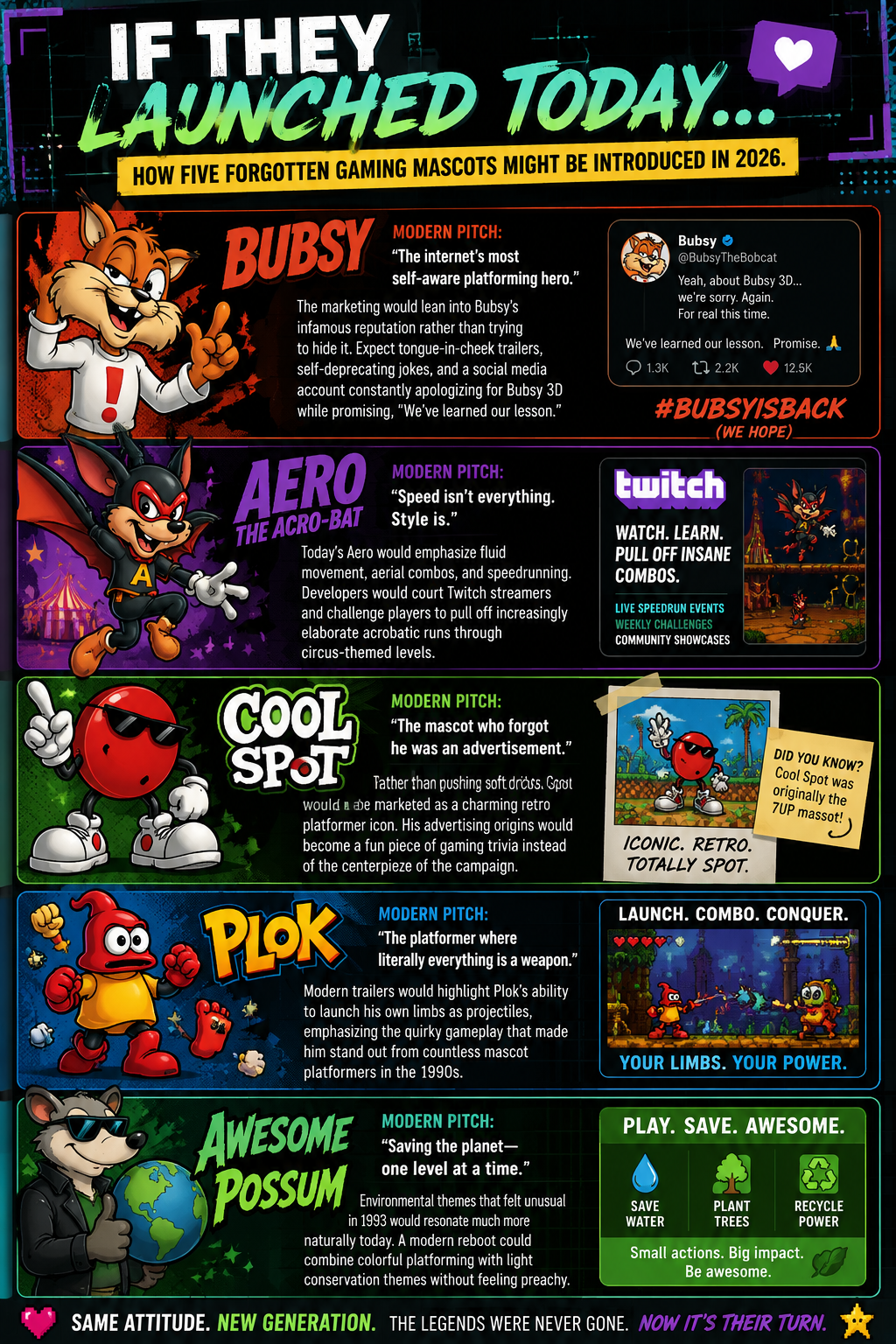
Everyone wanted a mascot at the time; here are some of the lesser-known ones that never took off.
Before Mario and Sonic became the undisputed faces of gaming, publishers were convinced that every successful console needed its own mascot. The result was a flood of anthropomorphic animals, attitude-heavy heroes, and bizarre cartoon characters – many of whom were heavily marketed, briefly successful, and then quietly disappeared.
The mascot craze of the early- to mid-1990s is a unique phenomenon in gaming history. The success of Sonic the Hedgehog in selling the SEGA Genesis convinced publishers that mascots are what sold consoles, not the games themselves. The era’s obsession with “cool” characters sporting sunglasses, sneakers, and excessive attitude was predicated on the Rule of Cool: The notion that the cooler the mascot, the more consoles it would sell.
While Mario and Sonic survived, dozens of other would-be gaming icons have largely faded from memory. Here are just a few lesser-known mascots that became casualties of the Console Wars.
Why Every Company Wanted a Mascot
Mascots were popular for a variety of reasons. First and foremost, mascots gave hardware manufacturers and game publishers a recognizable identity, so you could instantly tell what was what. Furthermore, video game marketing in the 1990s increasingly targeted children and teenagers, so it was theorized that mascots would appeal to this younger demographic.
Character merchandising was also important – nearly as important as the games themselves. Merchandising opened up a new revenue channel for game companies, helping them diversify. There was also the influence of Saturday morning cartoons and comic books.
Finally, “attitude marketing” was a defining characteristic of video games in the 1990s. Every publisher wanted to be seen as full of attitude and rebellious, because at the time, that’s what sold consoles.
The Forgotten Contenders
Aero the Acro-Bat
Aero the Acro-Bat was Sunsoft’s answer to Sonic the Hedgehog. The Aero video games frequently involved circus settings and acrobatic gameplay. These games produced multiple sequels, but very little long-term recognition. The game series – and its mascot – ultimately disappeared because the 16-bit platformer market became oversaturated. Another nail in Aero’s coffin? Gaming trends shifted toward 3D instead of 2D.
Aero the Acro-Bat 2, the sequel to the first game, launched in late 1994, just as the video game market was shifting its focus to next-generation consoles like the Sega Saturn and the PlayStation. Ultimately, the game – and its mascot – didn’t survive the shift.
Bubsy
Bubsy was Accolade’s ambitious mascot, backed by a massive advertising campaign and memorable catchphrases that made him relatable. The first entry in the Bubsy video game series was released in 1993, and multiple sequels were planned. These sequels were ultimately scrapped after Bubsy 3D flopped in 1996, and from 1999 onward, ownership of Accolade and the Bubsy games changed several times.
An orange bobcat with a catchphrase of “What could possibly go wrong?”, Bubsy was a loudmouthed wisecracker who also appeared in a television cartoon of the same name.
Bubsy ultimately appeared in 7 different games across the SNES, SEGA Genesis, Game Boy, Atari Jaguar, and other consoles. An emulated re-release of the first two Super Nintendo titles, called Bubsy Two-Fur, was published on Steam in December 2015; in 2025, Atari released Bubsy in: The Purrfect Collection, a compilation of the series’ first four games, for Nintendo Switch, Xbox, and PlayStation 5.
Zool
Marketed as “the ninja from the Nth Dimension”, Zool was a mascot released during the Amiga era before moving to consoles. Originally developed in 1992, the game Zool: Ninja of the Nth Dimension was meant to compete with Sonic the Hedgehog. The first Zool game featured Zool collecting various items in different candy-themed stages. A fast platformer, the game involved jumping puzzles and ninja attacks like fireballs.
The original Amiga game received critical acclaim for its great graphics and sound, and in 2021, Sumo Digital Academy developed a remastered version called Zool Redimensioned for Windows computers and the PlayStation 4.
Zool ultimately failed to achieve mainstream popularity due to harsh competition, blatant product placement in the games, and frustrating gameplay. The game also suffered from rushed level design and slippery controls.
Cool Spot
Yes, the 7UP mascot Spot was part of a video game. Released in 1993 for the Sega Genesis, Super Nintendo, and Game Boy, Cool Spot was a single-player platformer in which the player can jump from platform to platform and attack by throwing soda bubbles.
Each level of the game involves rescuing other cool spots by collecting a certain number of “spots” per level. The game would ultimately sell one million copies, and in 1996, Super Play ranked the SNES version number 100 on its list of the top 100 SNES games of all time. A sequel, titled Spot Goes to Hollywood, was released in 1995.
This game had surprisingly solid gameplay despite featuring an advertising character, and it demonstrated that licensed games weren’t always terrible.
Awesome Possum
Awesome Possum…Kicks Dr. Machino’s Butt is a game for the Sega Mega Drive and Genesis that was released by Tengen in 1993. This game was unusual for its time in that it had a number of lines of speech, and its educational and pro-environmental message set it apart from other games at the time.
Awesome Possum…Kicks Dr. Machino’s Butt featured the player character, a possum, collecting cans and bottles & answering environmental questions to earn power-ups that would help in the ultimate fight against Dr. Machino. The game also involved other animals that the player character could use to activate special abilities, including Rad Rhino, who catapulted the player character, and Killer Bee, who enabled the player character to fly.
Awesome Possum…Kicks Dr. Machino’s Butt has been the subject of great controversy in the gaming press, with some magazines praising it for its design, while others calling its main character narcissistic and annoying. Critics say the game had a strong concept but average execution, making Awesome Possum a mascot that almost nobody remembers today.
Rocky Rodent
Rocky Rodent was Irem Software Engineering’s unusual hair-powered platformer. This 1993 Super Nintendo game, known in Japan as Nitropunks: Mightheads, began with the title character Rocky eating at a restaurant. However, Rocky accidentally ate an envelope with a mobster’s protection money in it; as a result, the restaurant owner’s daughter is abducted by the mob. The restaurant owner asks Rocky to find and retrieve his daughter, with the promise of an all-you-can-eat buffet if he succeeds. The player uses four different hairstyles to play the game, each one providing different abilities.
This platformer game was unusual for its time and involved creative gameplay mechanics, but it was overshadowed by stronger competitors, and as a result it never saw commercial success. Today, though, the title maintains cult status among video game collectors.
Zero the Kamikaze Squirrel
Released in 1994 for the SEGA Genesis and Super Nintendo, this game is a spinoff/sequel to the Aero the Acro-Bat series. The game follows Zero, Aero’s rival, as he fights an evil lumberjack who is deforesting his home. Zero fights the lumberjack in a paper factory and aboard a flying ship.
Electronic Gaming Monthly gave this game high marks across all categories, noting that its innovative moves and vibrant graphics created an excellent experience. Power Unlimited, on the other hand, decried the game’s weak plot, hard-to-use controls, and overall level difficulty.
Why Most Mascots Failed
All of these forgotten mascots failed for one of four reasons.
Several of these mascots chased trends instead of creating them – they would try to duplicate Sonic’s speed or Mario’s platforming, for instance, instead of establishing a unique identity.
There was also a case of mascot overload in the 1990s – gamers simply couldn’t remember dozens of similar characters, and retail shelves became crowded with effectively interchangeable platformers.
The shift to 3D was also a challenge for these mascots, with the PlayStation, Nintendo 64, and SEGA Saturn changing player expectations. Many 2D mascots failed to make the leap.
Finally, publishers frequently moved on as marketing budgets shifted toward franchises rather than characters. Mascots would frequently disappear after one or two disappointing releases.
The 1990s console wars weren’t fought by Mario and Sonic alone. Every publisher dreamed of creating the next gaming superstar, resulting in a wave of quirky mascots that briefly dominated magazine covers and television commercials before fading into obscurity. While most never became household names, they remain fascinating reminders of a time when personality – and plenty of attitude – was considered just as important as gameplay.