The Rise and Fall of the Video Game Rental Store
How a weekend trip to the rental store became a defining ritual for a generation of console gamers.
“So what are you renting this weekend?”
We’re all familiar with the old Friday night ritual – school lets out, and as soon as you get home, you jet off to the local video store to browse shelves packed with games for the SNES, SEGA Genesis, PlayStation, or Nintendo 64. Back then, when you couldn’t browse online game libraries for hours, you simply had to judge a game pretty much entirely by its box art – if it looked cool, you rented it.
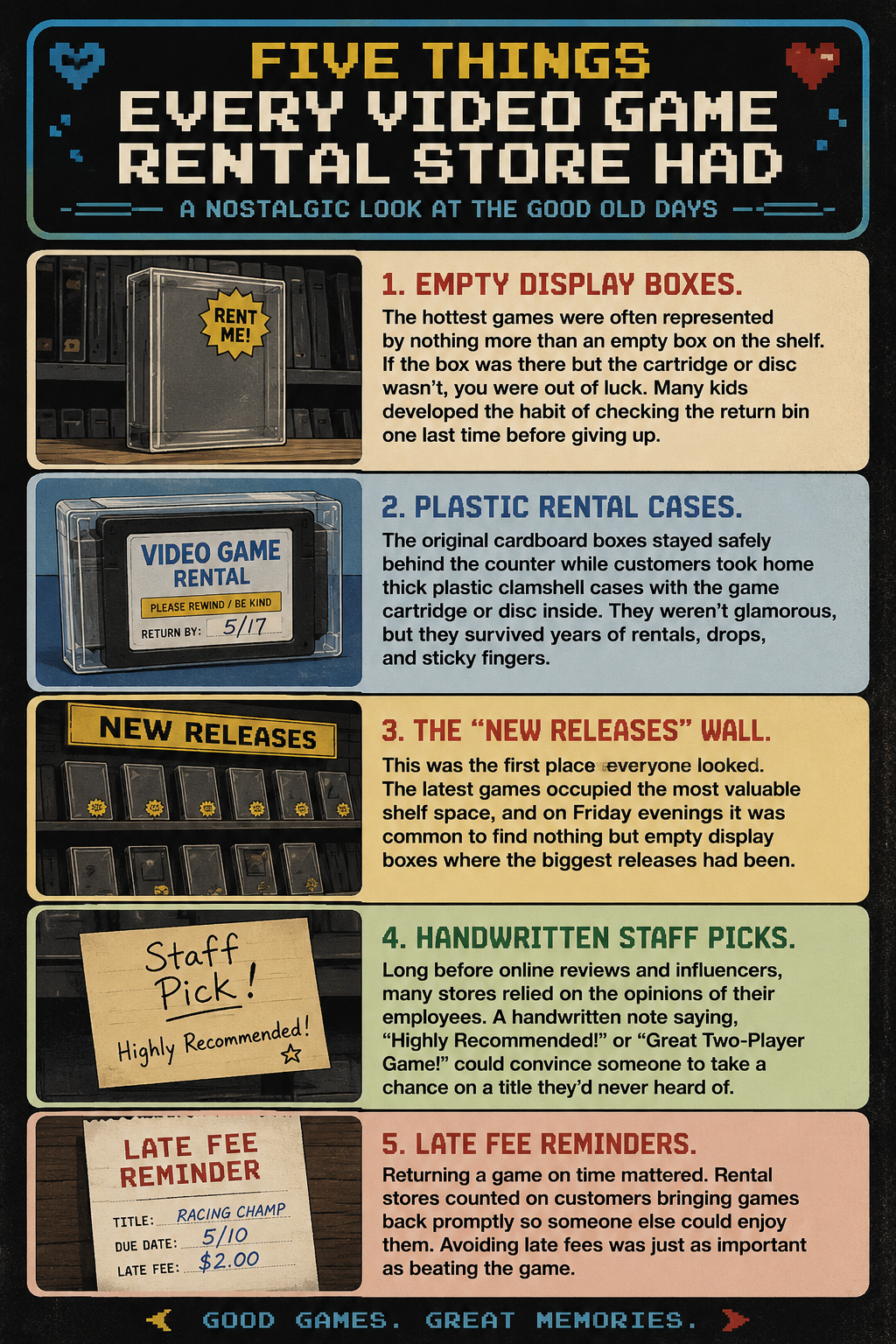
Next came the excitement of bringing the game home to play for the first time – and, sometimes, the disappointment of finding an empty rental box and having to go back to the store.
For an entire generation of gamers, renting wasn’t just a cheap way to play games – it shaped what we played, how we played, and even which games became popular. Here’s what made video game rental stores fun.
The Golden Age of Game Rentals
Video game rentals exploded during the late 1980s and throughout the 1990s. Back then, games were very expensive to buy, and most gamers only received a handful of games each year – usually at Christmas or for a birthday gift. Renting was an affordable way for players to experience dozens of titles for a fraction of the price of owning.
Chains like Blockbuster (RIP) competed with local independent stores to provide gamers with a wide array of games, from RPGs to action-adventure games and more.
Browsing Was Part of the Fun
Today, digital storefronts have replaced video game rental stores. But in the 90s, the video game rental store was a rich place of discovery where every shelf seemed to promise another hidden gem. Cover art often sold the games on the shelves, but reading the back of the box mattered as well – because that was the only way you could figure out what kind of game you were looking at.
Recommendations for games to play often came from employees or friends – people you trusted. There were often handwritten recommendation cards on the shelves praising the best parts of the games, while security sleeves prevented theft.
Rental Manuals Were…Unique
The video game manual has become a lost art. But when you rented a game, the manual was usually missing, torn, covered in someone else’s writing, or held together with tape. It was…an experience. And it inevitably became part of the charm of renting video games.
The Weekend Challenge
Renting video games changed how people played those games. Players would often try to beat games in two or three days, leaving their consoles running overnight so they wouldn’t lose their progress. (This was before save systems became universal.) Players would sometimes write down passwords for games that enabled password-based saves, so they could pick up where they had left off.
RPGs often didn’t get their proper due, because players had to rush through them to get to the ending. Players would even try to memorize difficult sections of games so they could progress faster the next time they rented that particular title.
Many classic memories for gamers exist simply because rentals imposed a deadline.
Rental Stores Helped Hidden Gems Find Audiences
During the 80s, 90s, and early 2000s, there were a number of major hit titles that every player owned. But for every Pokémon or Sonic title, there were ten lesser-known games that never went mainstream. Many of these games saw at least a modicum of commercial success because players took a chance on them. This led players to develop unexpected favourites that they never would’ve bought at full price. It also enabled players to rent lesser-known multiplayer games for sleepovers, so friends could get in on the fun of discovery as well.
In sum, rentals lowered the risk of experimentation, which increased game discovery. Many players discovered games like EarthBound, Harvest Moon, or Goof Troop because a rental only cost a few dollars instead of a full retail purchase.
The Rental Store as a Social Hub
The video game rental store itself became a part of gaming culture. People would swap recommendations while at the store; meanwhile, employees always seemed to know what was worth playing. Friends would meet at the rental store, arguing about which new release was the best or which system had better games. It was a unique social experience for gamers, particularly during an era when multiplayer required people to play with you in-person.
Why Rental Stores Disappeared
Rental stores died a slow death for a variety of reasons. Several forces converged to make rentals redundant.
First and foremost, games got longer. While this almost certainly improved quality of life for gamers, it meant that you couldn’t finish a game in a weekend anymore.
Second, online reviews replaced the word-of-mouth recommendations of store employees, which means you didn’t have to leave your house to discover new games. Digital storefronts and subscription services, meanwhile, meant that you could buy or rent games from the comfort of your couch.
Finally, the collapse of the movie rental store as a business model was the nail in the coffin for video game rentals. Streaming options diversified, which cut the rental stores’ profits and drove them out of business.
The decline wasn’t all of a sudden, and it wasn’t the result of any one factor. It was gradual, it was complex, and it was sad.
What We Lost
Modern gaming offers incredible convenience – you can discover new titles, and download them to your console, without ever leaving your house. But rentals offered experiences that downloads don’t.
During the video game rental era, we discovered new games by browsing. There was a shared local excitement for new games, and physical collections on shelves helped build anticipation for Friday nights. When video game rentals died, so, too, did video game rental culture and the sense of discovery that came with it.
Video game rentals were about more than just renting. The rental store wasn’t just a place to borrow games – it was a place where gaming communities formed, recommendations spread, and lifelong memories began. For many retro gamers, the best part of the weekend wasn’t getting home – it was finally seeing that one empty rental box replaced by a copy waiting on the shelf.