When Cheat Codes Were a Social Network
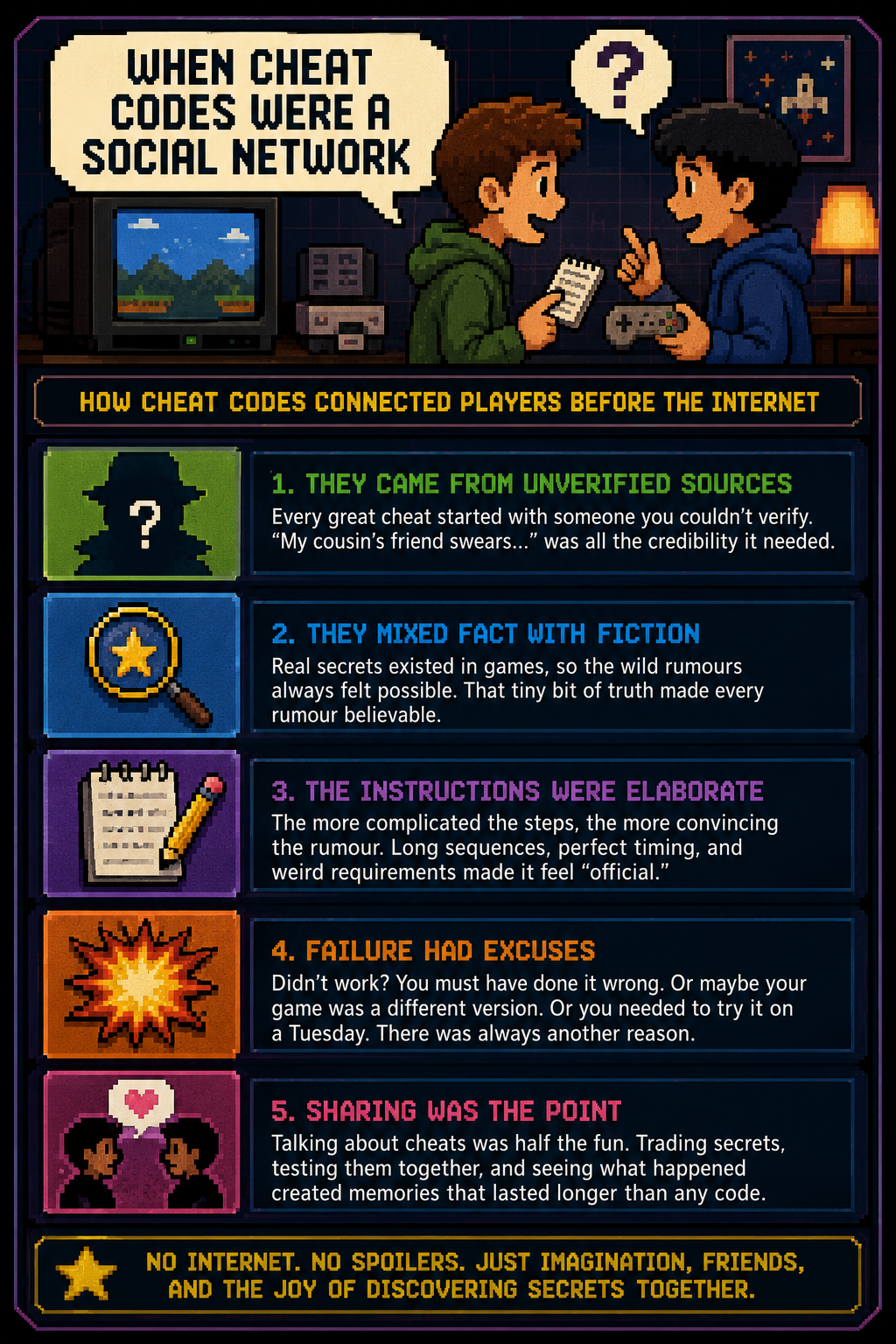
A tribute to a simpler, pre-Internet time when cheat codes weren’t everywhere.
Chances are you remember it: The first time another kid told you about the “Up, Up, Down, Down, Left, Right, Left, Right, B, A” cheat code – the famous Konami Code. Maybe you were on a school bus. Maybe you were at summer camp. Or maybe you were playing a game with friends.
Retro gamers fondly remember the days when we had folded notebooks full of passwords, or a friend who insisted they knew how to unlock a secret character. Back then, cheat codes weren’t just gameplay shortcuts – they were information with a social element. They traveled from person to person, creating communities through the scarcity of knowledge.
The Birth of the Cheat Code
Developers created cheat codes for a variety of reasons – maybe they were working on debugging during development, or maybe they were testing out new levels or game mechanics. In the 80s, 90s, and early 2000s, hardware limitations made testing difficult, which is why developers invented cheat codes to make game testing faster and simpler.
While these codes were intended to be developer-only knowledge, some codes accidentally remained in retail releases, while others were intentionally left in for player use.
The Konami Code is the most famous example of a cheat code, initially created by developer Kazuhisa Hashimoto for the game Gradius on the Nintendo Entertainment System. In Gradius, entering the code would immediately unlock all available power-ups.
This code, the “Up, up, down, down, left, right, left, right, B, A” code, was popularized in Contra, when it granted 30 lives. The code has since become a significant Easter egg in gaming.
Hashimoto originally created the code because he found Gradius to be too difficult to test; it was intended to be removed before commercial release, but the developers left it in the game because they found that removing it could cause bugs and glitches.
The Konami Code has since appeared in Tetris for the NES, Castlevania: Legacy of Darkness for the Nintendo 64, Hollow Knight: Silksong, and Assassin’s Creed III.
The Konami Code eventually became so popular that its influence extended beyond gaming; the Bank of Canada infamously used it on their website for the commemorative $10 bill, where entering the code plays a chiptune version of the Canadian national anthem.
Another famous cheat code was the Doom level select cheat, where typing the string idclev## while playing (where ## was replaced with the two-digit level number) would cause players to warp to the selected level.
Perhaps no game is more famous for its cheats, though, than GoldenEye 007 for the Nintendo 64. GoldenEye 007 cheats, though, are complex to activate; the button presses must be entered in the cheat menu using the first controller. Then, players must exit the cheat menu and re-enter it to activate the code. GoldenEye 007 featured cheat codes enabling Paintball Mode, Infinite Ammo, Invincibility, and more.
Reliable Information Was Hard to Find
Today, every cheat code for every game is just a Google search away. But in the 80s and 90s, we didn’t have Google, YouTube, or Reddit. Cheat codes had value because they were difficult to obtain; a player who knew a lot of cheat codes became known as an expert.
Back then, every classroom had one kid who somehow knew every secret cheat code, and even had them written down. For gamers, being this person was a special form of social leverage and status.
The Playground Internet
In the retro gaming era, cheat codes weren’t readily accessible. Instead, they spread through friends at sleepovers, on bus rides, at birthday parties, and in the schoolyard. Or you’d have an older brother or cousin who would tell you about a cheat code. Someone would whisper a cheat code at morning recess, and by lunch, half the school had heard it.
Video game rental stores were also a valuable source of cheat code information; employees would often share tips with players, and sometimes, players would accidentally leave handwritten notes inside rental cases containing a summary of a game’s cheat codes.
Local video game shops were another source of information on cheat codes. There were often bulletin boards with cheat codes listed on them, while talking with staff could sometimes reveal a sought-after cheat code for a particular game.
In sum, every interaction became an opportunity to exchange information, making cheat codes a social phenomenon.
Gaming Magazines Became Search Engines
Before online databases, we had gaming magazines. Magazines like Nintendo Power, Electronic Gaming Monthly, and GamePro would often feature hidden secrets, cheat code sections, password lists, and reader submissions about hidden cheat codes that they had discovered.
These magazines built a great deal of anticipation among players, who would often have to wait a whole month to discover new cheats.
The Notebook Era
Before cheat codes were readily available online, players would keep track of them in password books, cheat notebooks, on folded scraps of paper, in binder inserts, or even through photocopied magazine pages. Sometimes players would scribble passwords in the back of the game manual, tape a cheat list inside the game case, or lend a notebook to a friend.
Many gamers had the “cheat drawer”, where cheat codes were stashed. Others would keep cheat codes with their gaming setup, or inside a console box. This information quickly became part of a gamer’s personal gaming collection, adding a personalized element and creating new value.
Not Every Cheat Was Real
While developers did (and still sometimes do) put cheats into video games, not every supposed cheat code actually worked. There were plenty of fake cheat codes swirling around through schoolyard myths, and magazines running April Fool’s Day jokes helped proliferate a list of fake cheat codes.
Players believed these codes because games often did really hide secrets, contain genuine Easter eggs, and feature cheat codes that worked. The line between truth and fiction was blurry, and with official sources of information few and far between, players had to rely on a patchwork of knowledge that sometimes worked and sometimes didn’t. This made discovering new cheats an even more fun experience, because you never knew if a cheat would work or not.
Why Sharing Cheats Was Fun
Sharing cheat codes was a fun new way to discuss games with other players because of the social psychology element behind it. Sharing a cheat code meant that you were simultaneously helping a friend while showing your expertise, which meant you were improving your own social standing in your local gaming community. Cheat codes gave gamers a reason to talk to each other about games.
Plus, it was an easy way to build friendships and start conversations with other gamers. In effect, cheat codes became a form of social currency, giving players who knew them an opportunity to talk about gaming with others.
The Internet Changed Everything
When the Internet began to mature, it resulted in the death of cheat code secrecy. Suddenly, cheat codes were everywhere – on GameFAQs, dedicated cheat websites, in IGN articles, in YouTube walkthroughs, and even on game Wikis.
The advantages of this change were that databases could be complete, and players could get instant answers about cheats. But in the process, gamers traded off something important: The excitement of discovering secrets or exchanging secrets with others.
Knowledge Was Part of the Game
Before online communities, cheat codes travelled by word of mouth, with every player contributing to the in-person social network that enabled cheat codes to connect people. Long before Discord servers, Reddit threads, and gaming Wikis, there was a different kind of social network built on whispered cheat codes, dog-eared magazine pages, and the excitement of passing a secret to the next player. Maybe that’s why so many of us still remember the first cheat code we ever learned. We don’t just remember the code – we remember who told us.
While cheat codes are easier to find now than ever before, part of the magic of cheat codes was the discovery – and the Internet has taken that away.