When Every Game Had a Secret: The Pre-Internet Era of Gaming Rumours
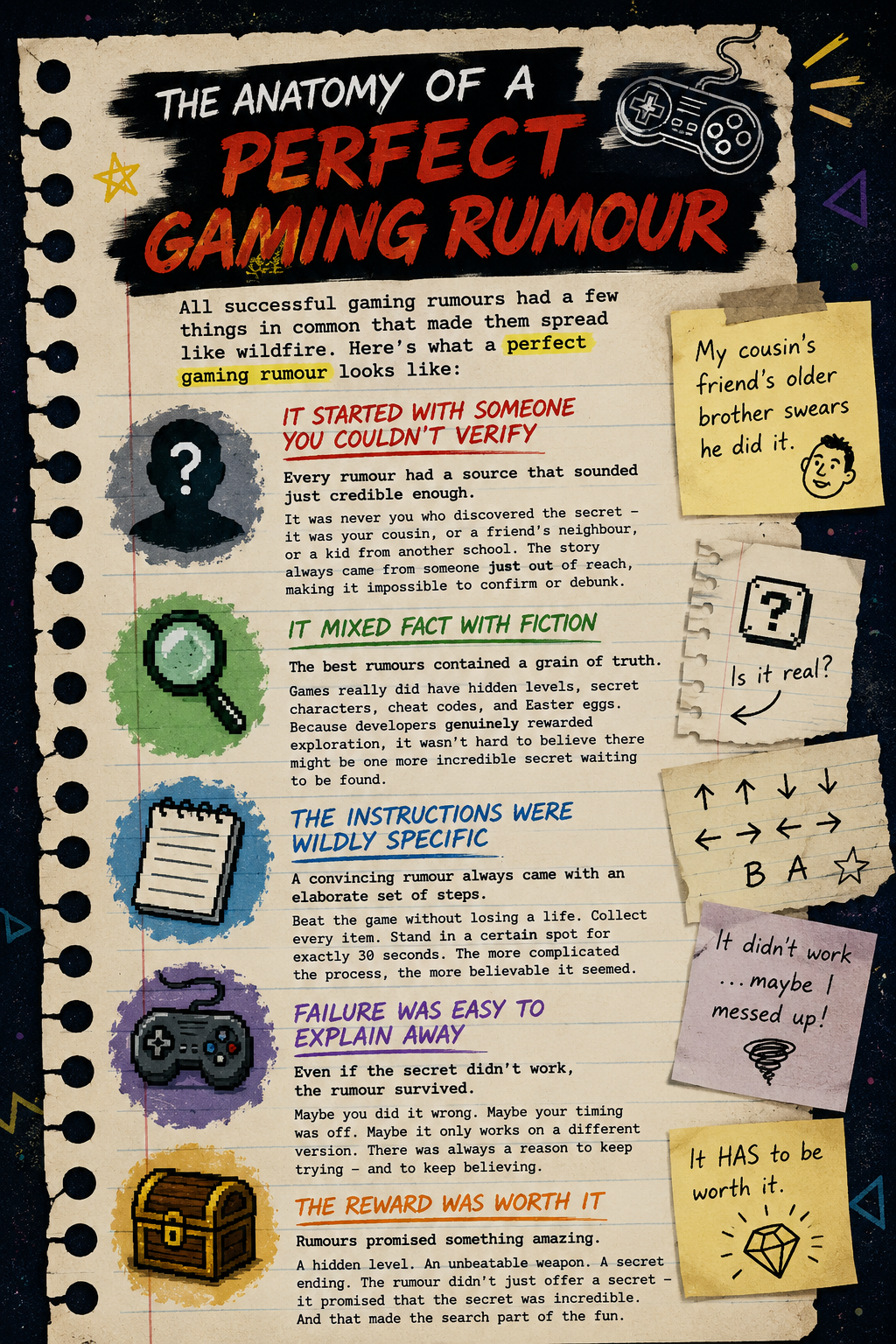
Before Reddit and YouTube, we had schoolyard rumours.
All of us gamers have the same childhood memory.
“My cousin’s friend unlocked Luigi in Mario 64!”
“You can revive Aerith!”
“Hold A+B to catch Pokémon!”
We didn’t have the Internet back then – we didn’t have an entire world of knowledge at our fingertips. Instead, what we had was a patched-together network of information gleaned from schoolyard playgrounds, sleepovers, gaming magazines, phone hotlines, and other word-of-mouth sources.
Gaming rumours weren’t a flaw of the era – they were part of the magic. The mystery is part of what made the games feel larger than they actually were.
Here’s a brief look at some of the biggest gaming rumours of the 1980s, 90s, and 2000s – and why they thrived.
Rumours Spread Easily in an Info Vacuum
Back in the 90s, reliable information about games – and their secrets – was scarce. We didn’t have Google. We didn’t have YouTube walkthroughs. There were very few strategy guides in existence, and the ones that did exist were expensive. Players had to experiment in order to figure out what worked.
Compounding this lack of information was the fact that games were actually full of secrets. There were hidden levels, cheat codes, secret unlockable characters, Easter eggs, and alternate endings. And because these real secrets existed, the fake ones felt believable.
Plus, kids were perfect storytellers. Everyone had an older cousin or a friend at another school who swears they found Mew hiding under a truck in Vermillion City. Nobody could verify anything, which is why these rumours took hold as strongly as they did.
Luigi in Super Mario 64
Luigi was originally meant to appear in Super Mario 64 – but he was cut due to time constraints and memory limits. Players searching the game’s courtyard would eventually find a Star statue with blurry text that seemed to read “L is Real 2401”, which led to speculation that there was a way to unlock Luigi in the game. This rumour was so pervasive that it led fans to mod Luigi into the game decades later.
This gaming rumour, that Luigi was unlockable in Super Mario 64, eventually led Nintendo to put him in Super Mario 64 DS, giving him unique abilities like running on water. To unlock Luigi in Super Mario 64 DS, you’ll need to enter Big Boo’s Haunt, use a Power Flower to float to an elevated platform in the main foyer, and enter the door to Luigi’s painting.
Next you’ll need to complete a door puzzle and navigate a brick maze to a mirror room. After that, you’ll need to defeat King Boo using the ground-pound attack, and claim the Luigi Key. Take the key to the character door marked “L” on the second floor of the castle, and you’ll unlock Luigi.
Reviving Aerith
Final Fantasy VII gave us one of the most tragic and heartbreaking character deaths of all time. Aerith Gainsborough is praying at an altar in the Forgotten Capital when Sephiroth descends from the sky and stabs her through the back, killing her.
Aerith’s death in this game strips the player of a key party member at a pivotal moment. Adding to the drama is the fact that up until that point, all of the party characters were able to be revived if they died. The game developers even gave Cloud a monologue in which he laments Aerith’s death, proving to the player that Aerith is gone for good.
Aerith’s unique abilities gave the player key advantages in battle, and her death is seen as a major blow to the player’s ability to prevail in the game. As a result, fan desire to see Aerith survive led to the proliferation of rumours that she was somehow revivable in the game.
Endless fake walkthroughs spawned as a result, each one with hundreds of impossible steps that players were expected to follow if they wanted to revive Aerith. These walkthroughs demonstrated just how emotionally invested in Aerith players became, and they serve as a testament to the storytelling power contained in the Final Fantasy series.
Mew Under the Truck
This is perhaps gaming’s most famous myth. The claim goes that in Pokémon Red & Blue, in Vermilion City, near the S.S. Anne, there’s a secret ledge with a pickup truck on it that players can access using the Surf move. That part is true, at least theoretically.
Normally, the ship – and therefore access to that part of the water – would depart before players were able to get Surf. Some players found a workaround whereby they could trade a Pokemon from another game that knows Surf, or deliberately lose a battle on the S.S. Anne after getting Surf, sending them back through the town without the ship departing.
The rumour was that if you could access the ledge and check the pickup truck, you’d find a Mew hiding underneath it. This was ultimately untrue in the original games, although later releases placed a rare item beneath the truck as an in-joke.
This rumour seemed believable because, ironically, real glitches in the games did enable players to eventually obtain Mew legitimately.
Sonic and Tails Rumours
There are plenty of rumours about Sonic and Tails across various Sonic the Hedgehog games. First and foremost, there’s the Super Sonic transformation rumour. In later Sonic the Hedgehog games like Sonic Superstars, it’s possible for Sonic to transform into Super Sonic by collecting all seven Chaos Emeralds throughout the story campaign. The Super Sonic ability, when activated, gives Sonic a substantial speed increase and invincibility, while draining his rings for fuel. The rumour here is that this ability is unlockable in earlier Sonic games, which it isn’t.
Another rumour was that you could unlock Sonic and Tails in Super Smash Bros. Melee. This urban legend originated as an April Fool’s Day prank in Electronic Gaming Monthly, when the magazine published a short article claiming Sonic and Tails could be unlocked by defeating 20 enemies in Cruel Melee mode. While this rumour was false, Sonic creator Yuji Naka did confirm that Sonic had been planned to appear in Melee but was cut for time.
Mortal Kombat Secrets
The Mortal Kombat series spawned a number of rumours relating to hidden fighters. Rumoured characters in this series included Kano, Skarlet, Blaze, and Hornbuckle. It’s no secret that Mortal Kombat and three of its successors incorporated unlockable characters into their game design. These secret characters typically have greater speed and superior powers compared to normal characters, making them desirable for players.
The rumour part here is that most of these secret characters aren’t actually unlockable – they simply exist as enemies to give the player an extra challenge. This changed, though, in Mortal Kombat 3, where players can successfully unlock secret characters through Ultimate Kombat Mode.
While several Mortal Kombat games do have unlockable characters, gamers have come up with several supposed unlockable characters that don’t actually exist. For instance, the character Nimbus Terrafaux was supposed to have appeared in the original Mortal Kombat on the SEGA Genesis; this ultimately turned out to be an April Fool’s Day prank by Electronic Gaming Monthly.
Pokémon Catching Tricks
“Oh no! The Pokémon broke free!”
Everyone on the schoolyard had a so-called “guaranteed” way to never see those words pop up on the screen again. Sometimes it was holding the A button. Sometimes it was pressing the B button. Sometimes it was shaking the Game Boy in time with the Poké Ball shakes. Sometimes it was looking away from the screen. Some players even swear that holding Down + B works every time.
But none of these methods actually work. The only surefire way to catch a Pokémon is with the Master Ball, which, as everyone knows, has a 100% success rate. (But if you use the Master Ball on a Caterpie, we’re gonna throw hands.)
Gaming Magazines Added Fuel to the Fire
Gaming magazines bear some of the responsibility in allowing these rumours to proliferate. “Tips” sections often published reader submissions, which tended to be inaccurate. These magazines would also publish annual April Fool’s Day issues, which would fool readers into believing some of the outrageous claims made in those magazines. Some magazines even intentionally played along with the rumours as a way of having fun with readers.
Meanwhile, official strategy guides sometimes left secrets undiscovered, and mystery helped to sell gaming magazines, so there was money to be made in promoting the notion that every game had a secret.
Developers Loved the Mystery
Developers themselves are also a large part of why gaming secrets grew. They would often hide absurd Easter eggs in their games, including secret endings that encouraged speculation and cheat codes that rewarded experimentation. Some developers intentionally teased fake secrets as a marketing tactic. Game marketing ultimately benefitted from schoolyard discussions, giving game companies a financial incentive to whisper about cryptic unlock requirements or hidden characters.
The Internet Ended the Age of Rumours
Ultimately, the age of gaming rumours died the same death as the physical magazine: The Internet killed it.
Today, there are wikis, Discords, Reddit threads, launch-day guides, and streamers documenting every secret within hours, which means mystery rarely survives release week. While the gaming community has gained much from the Internet era, the loss of game secrets has taken with it something intangible about gaming culture.
Gaming has never been more accessible, but something disappeared along the way. A sense of wonder, of discovery. A sense of shared imagination and community experimentation.
Sometimes, believing the rumour was more fun than proving it wrong. Ultimately, the greatest secret wasn’t hidden inside a cartridge – it was the feeling that somewhere, somehow, there was still one more thing waiting to be discovered.