The Lost Art of the Video Game Manual
There was a time when the video game manual itself was a phenomenon in its own right.
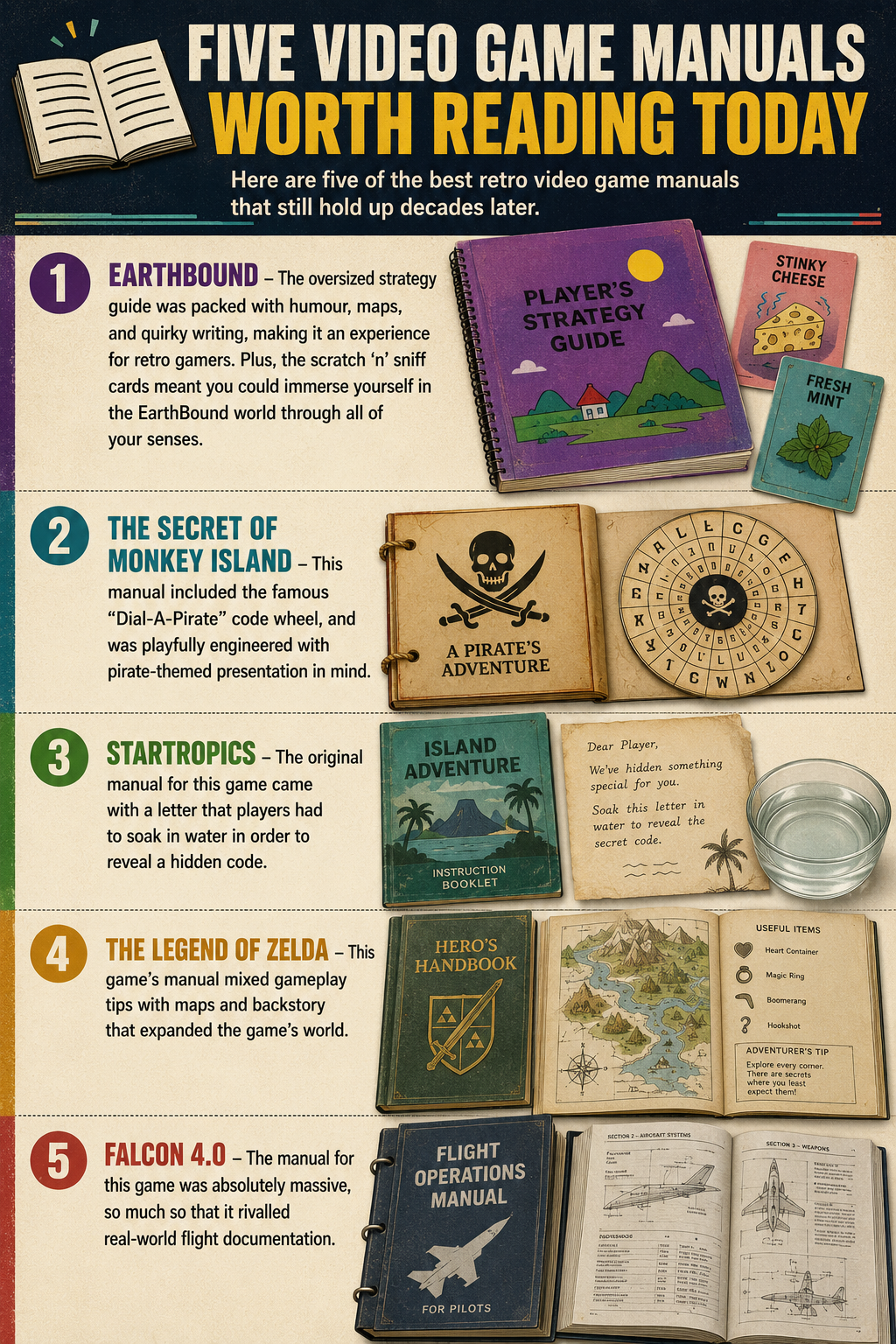
Do you remember opening up a new game and flipping through the manual before ever booting up your console? If so, you’re part of a dying generation of video game manual readers. Manuals weren’t just instructions – they were part of the cultural experience of video games. While gaming has become more accessible with in-game tutorials, something intangible has been lost along the way. Here’s why the video game manual mattered.
Manuals Were Your First Adventure
Back in the retro era, buying a game often meant reading the manual in the car ride home. Manuals introduced story and setting, characters, controls, enemies, and maps. They built excitement for the game before gameplay even began.
Manuals also filled technical limitations by telling stories that cartridges couldn’t. The Legend of Zelda and Final Fantasy VI are prime examples of this; they used the manual as a storytelling venue, not just an operations tutorial.
Well before you booted up the game, the manual is what got you into the world. With the death of video game manuals, something about creating immersive experiences was lost along the way.
Manuals Were Works of Art in and of Themselves
Video game manuals weren’t just documentation. They were art. Most manuals had full-colour illustrations of in-game play, plus commissioned artwork of the game characters to illustrate the world you were about to enter.
Some manuals even included fold-out maps, character profiles, fictional documents and lore, or – in the case of EarthBound – themed scratch ‘n’ sniff cards. Video game manuals were miniature art books, and each publisher from Nintendo to Square to Sega had their own signature style.
Nintendo’s manuals were designed to be welcoming, especially during the NES and SNES eras. These manuals were colourful and bright, with large screenshots and callout boxes, cartoon-style illustrations, character bios, enemy galleries, clear explanations for young players, and story summaries that expanded on the game’s premise. Nintendo often struck a balance in their manuals between instruction and entertainment, making their manuals feel approachable rather than technical.
In contrast, publisher Square often treated manuals like prologues to their RPGs. Typically, these manuals would feature extensive backstory, world maps, character biographies, class descriptions, explanations of items and types of magic, and beautiful artwork by the game’s artists. These manuals, for games like Chrono Trigger, helped players become invested in the world before starting the game.
SEGA’s manuals, meanwhile, were filled with attitude. These manuals featured bold typography, dynamic action poses, comic-book energy, high-contrast colours, and short, punchy writing.
For Capcom, manuals were about balancing gameplay clarity with visual appeal. Capcom manuals often included move lists, boss introductions, weapon descriptions, character illustrations, and gameplay tips for games like Resident Evil, Mega Man X, and Street Fighter II.
While every publisher had their own unique style, the best manuals shared three primary goals:
Teach the player without being dry or intimidating
Build anticipation by introducing the world, characters, and stakes before gameplay begins
Extend the experience beyond the cartridge, making the game feel like a complete package
This variety is part of what made physical game ownership memorable. Manuals weren’t standardized inserts – they were carefully crafted extensions of each publisher’s identity, and, in many cases, of the games themselves.
Learning Before Tutorials Existed
Modern games like Metroid Prime 4: Beyond have a tutorial level built-in, where you learn by doing. But early games often dropped players directly into gameplay without so much as a how-do-you-do. That’s why the video game manual was so crucial: It explained controls, power-ups, objectives, items, and enemy behaviour.
Some games were nearly impossible without reading the manual. Games like Civilization II relied heavily on the manual to teach you how to play the game.
In contrast, today, games have interactive in-game tutorials, tooltips, context-sensitive prompts, and accessibility settings that make learning the game while playing it much easier.
Why Manuals Disappeared
There are several factors that influenced the death of the video game manual. First and foremost, the advent of the Internet and digital game distribution meant that downloads couldn’t include physical extras. Secondly, rising printing costs made colour manuals prohibitively expensive for publishers. As a result, physical games replaced manuals with a folded quick-start guide.
Another reason for the death of the manual? Better game design. Games now teach players organically rather than relying on an instruction manual, which, one could argue, proves that game design has evolved. Plus, day-one patches have ultimately made printed instructions outdated, and environmental concerns led to less paper inside game cases.
This shift accelerated during the PlayStation 3 and Xbox 360 era, when digital downloads became popular. These platforms were among the first to enable players to download digital games, rendering manuals impractical and unnecessary.
The Few That Still Keep the Tradition Alive
While video game manuals are no longer part and parcel of the video game buying experience, there are remote corners of the gaming world where manuals are still a thing.
Collectors’ editions often include printed manuals, lore books, maps, stickers, and replica documents, capitalizing on fans’ desire for nostalgia and collectors’ need to own physical copies. There’s also significant display value at play, meaning collectors are willing to pay a premium for complete-in-box editions of popular games.
Another faction that’s keeping the manual alive? Indie developers. Independent game developers often include physical or digital game manuals with their games in an effort to invoke that same nostalgia that players have. Some examples of indie games that are keeping the manual alive include Hollow Knight, HighFleet, Tunic, Axiom Verge, and Horace.
There are even entire indie studios that have made manuals a part of their identity. Mega Cat Studios included a printed manual with nearly every new game it made for retro consoles, and the now-defunct IndieBox built its entire business around boxed indie games with full-colour manuals, soundtracks, and collectibles.
Manuals weren’t just instruction books. They transformed game buying into an event, and reading them became a large part of gaming culture. That’s why complete-in-box retro games go for much more than just loose cartridges. Modern games may be easier to learn, but opening a new game box today rarely carries the same sense of discovery that came with opening a retro game. Sometimes the first level of a great game wasn’t on the screen – it was turning the first page of the manual.