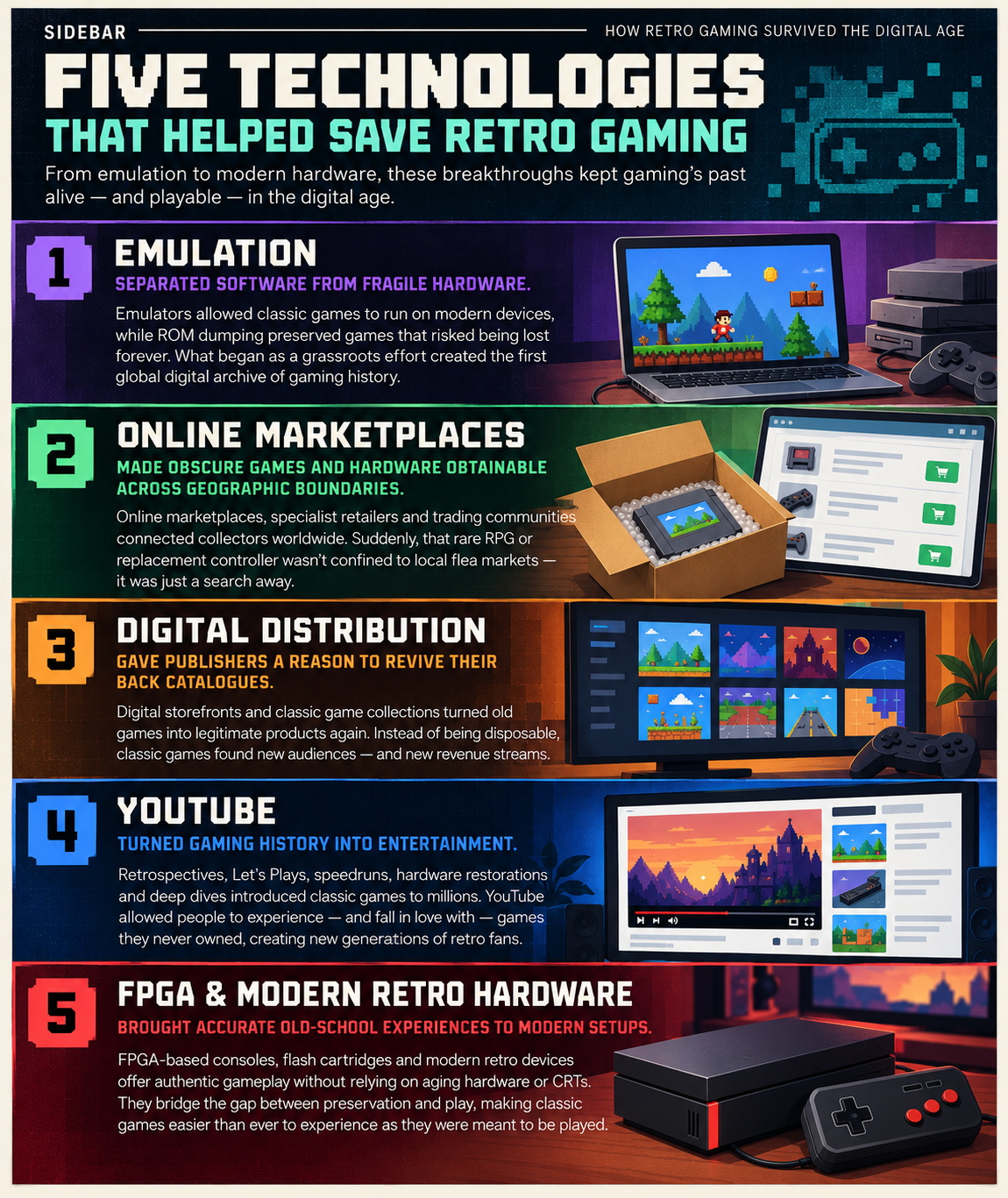
Here’s how old games made the transition to digital.
Retro gaming should have disappeared.
After all, the story of technology is evolution – replacing what came before. Streaming killed video rental stores, smartphones swallowed standalone devices, and digital distribution transformed how games are bought and played.
By that logic, things like cartridges, CRT televisions, old consoles, printed manuals, and games designed for obsolete hardware should’ve faded away.
But instead, retro gaming became a culture all its own.
The digital age didn’t kill retro gaming. Rather, digitization helped preserve retro games, made forgotten games easier to discover, connected previously isolated fans, and ultimately transformed nostalgia into a permanent part of gaming culture.
Before the Internet: When Old Games Simply Became Old
During the 1980s and 1990s, aging games were simply discarded. The gaming industry’s early years were defined by disposable games and consoles. Hardware generations moved quickly, publishers stopped manufacturing older games, and stores cleared shelf space for newer systems.
In order to find and play old games, players would have to encounter those games through hand-me-down consoles, garage sales and flea markets, rental stores selling off old inventory, used game shops, friends and relatives, or personal collections sitting in closets and basements.
Retro gaming wasn’t necessarily an established hobby yet. People played old games, but they weren’t necessarily consciously participating in preservation culture.
The arrival of the Internet changed all of that by giving scattered enthusiasts a way to find each other.
The Internet Gave Old Games a Second Life
The late 1990s and early 2000s Internet was a turning point for retro gaming.
Fan sites popped up to celebrate old games. Message boards and newsgroups spread the word about how to find and play them. FAQs and early gaming communities made discovery of new games and consoles simple.
Someone who was fascinated by an obscure console or forgotten RPG could discover that other people cared about it, too.
Online communities cropped up around documentation of obscure games, sharing walkthroughs and technical information, cataloguing regional releases, identifying prototypes and unreleased games, trading and selling old hardware, and even celebrating particular systems and franchises.
The Internet turned nostalgia from an individual experience into a collective one.
Emulation Became an Accidental Preservation Movement
The first great digital archive of video game history wasn’t built by museums. It was built by fans.
Emulators are largely responsible for keeping old games alive in the digital era. Emulators and ROM dumping enabled games designed for aging hardware to survive beyond the lifespan of the machines themselves.
Early console emulators and ROM preservation made it possible to dump games onto a computer, giving them new life in the digital space. Fan translation projects leveraged these technologies to create new localizations of region-specific games. ROM hacks and restoration projects resulted in all-new takes on old games. Arcade preservation became popular through projects like MAME. And games suddenly became accessible to audiences far outside of their original markets.
Now, ROM distribution has several legal and copyright controversies surrounding it. Unethical actors have used ROM ripping technologies to pirate and upload games to the Internet in a way that, allegedly, violates the copyright of the game publisher in question.
But there’s a world of difference between preservation and piracy. Whatever the legal complications, enormous amounts of gaming history were documented and preserved because enthusiasts cared enough to copy, catalogue, and study aging software.
Digital Distribution Made “Old” Games Commercial Again
Unofficial preservation initiatives are one way that old games survived and thrived in the digital era. But the other way started when publishers realized there was money to be made from their back catalogues.
Nintendo’s Virtual Console, launched for the Wii in 2006, enabled gamers to play games for the NES, SNES, Nintendo 64, SEGA Genesis, and various arcade systems on their Wiis. The Virtual Console was arguably the first licensed example of video game publishers making past titles available on modern consoles.
Another example was Xbox’s backwards compatibility, enabling newer Xbox consoles to play older Xbox games. Meanwhile, PlayStation Plus’ Classics catalogue enabled PlayStation Plus Premium members to play classic PlayStation games on their PS4 and PS5 systems.
There was a psychological shift when these official re-release platforms arose: Older games stopped being something that publishers had finished selling. Instead, a game released decades ago could suddenly become a commercial product again.
YouTube Turned Gaming History Into Entertainment
The rise of retro gaming content creation helped retro games proliferate throughout the Internet. YouTube streamers playing old games enabled people to experience games they had never owned – and sometimes, to experience games released decades before they were born.
Video content like retrospectives, Let’s Plays, speedruns, console histories, hardware restoration videos, game collecting channels, documentary-style gaming content, and “hidden gem” videos all created a secondhand form of nostalgia, enabling younger players to become fascinated by systems they themselves had never personally experienced.
In sum, someone born after the SNES era could still become obsessed with the SNES – meaning retro gaming stopped requiring firsthand nostalgia.
Social Media Made Nostalgia Constant
Social media platforms helped to accelerate retro gaming culture in a variety of ways. A screenshot from a game, a piece of box art, or a startup sound could instantly trigger memories and conversation.
Nostalgia thrives particularly well in short-form digital environments because gaming memories are often intensely visual and specific. This enabled collectors, historians, developers, and ordinary players to directly interact with each other and share their love of retro games. The past wasn’t sitting quietly in an archive anymore. Suddenly, it was constantly being recirculated.
The Strange Return of Physical Media
Here’s the central irony of retro gaming:
The more gaming went digital, the more players started to value physical objects.
Retro game collecting, complete-in-box collecting, cartridge restoration, CRT enthusiasm, aftermarket consoles, flash carts, and reproductions all took off in the digital era as a means of bringing the past into the present.
Digital convenience may have actually increased the emotional appeal of tangible gaming artifacts. After all, a cartridge isn’t just a way to access software anymore. The object itself is part of the experience of retro games.
Mini Consoles and the Commercialization of Nostalgia
Miniature consoles also helped drive nostalgia for retro games while simultaneously enabling gaming companies to cash in on retro gamers’ passion for games from the 80s and 90s. The NES Classic Edition, SNES Classic, SEGA Genesis Mini, and other similar products are all evidence that retro gaming has gone mainstream – after all, gaming publishers like Nintendo and SEGA wouldn’t make these consoles if there weren’t serious demand for them.
These mini consoles packaged nostalgia as an accessible consumer product: No hunting for cartridges that are 20 or more years old, no needing to buy a CRT TV at a flea market, and no complicated setup with 1,000 different component cables.
Publishers quickly discovered that they weren’t just selling old software – they were selling memory.
Indie Games Proved Retro Could Be a Style, Not Just an Era
The definition of “retro” began to expand when indie game developers started mimicking the common elements of retro games in modern releases.
Pixel art, chiptune music, limited colour palettes, and mechanics inspired by 8-bit and 16-bit games became deliberate artistic choices rather than technological limitations.
Games like Shovel Knight, Celeste, Stardew Valley, and The Messenger demonstrate that retro aesthetics can exist independently of old hardware.
As a result, retro eventually stopped meaning “old”. Rather, it became a visual and mechanical language that modern developers could deliberately use.
The Preservation Problem Isn’t Solved
Despite everything the digital age has done for preservation, games still remain remarkably fragile.
Digital storefront closures, delisted games, expired licenses, and server shutdowns all still threaten online versions of retro games.
Meanwhile, disc and cartridge degradation, failing optical drives, aging hardware, and games that are dependent on patches or authentication servers are killing off retro games faster than ever before.
So yes, the digital age helped save gaming history – but it also created entirely new ways for games to disappear.
That’s why museums, libraries, archives, preservation efforts, and fan communities matter so much in retro gaming – because they’ve found ways to keep these games alive despite the games’ tendency to die out.
The Past Found a Future
Retro gaming survived not because it resisted technological change, but because enthusiasts repeatedly used new technology to keep old technology alive.
The Internet connected collectors. Emulation preserved software. Digital storefronts revived old catalogues. YouTube documented gaming history. Social media kept nostalgia circulating. Modern hardware made old games accessible. And indie developers turned retro design into a contemporary aesthetic.
The digital age didn’t turn gaming’s past into a museum exhibit. Rather, it made the past playable.